Welcome to The Latter-day Saint Organist's Resource Blog

The purpose of this blog is to help pianists learn to become true organists. Many individuals believe that if you play the piano you can play the organ, but the instruments differ greatly. While this blog is specifically geared towards members of The Church of Jesus Christ of Latter-day Saints, much of the information shared can be utilized by all. I hope that the information I share here will help you become an effective organist in your ward, stake, or other congregation.

Feel free to browse and search this blog. It was started in January 2010 and while new posts aren't added very often, this blog contains a wealth of information and is a wonderful resource for all organists. If you're a new reader, you can find the first lesson here: Before We Begin: Acquiring the Essentials. Also, please "like" the corresponding facebook page, which is updated more often. A link is provided on the right sidebar, or you can click here.

Thanks for visiting!

Sunday, March 28, 2010

Sunday Song: Bach's In dulci jubilo BWV 751

To round out Bach month, here's an additional Sunday Song.

Johann Sebastian Bach's Chorale prelude "In dulci jubilo" in G major BWV 751 played by André Isoir at the Gabler organ of the Weingarten Basilika in Germany.

Notice the novelty of the cuckoo stop, and the use of weights.

Sunday Song: Bach's Toccata in C Major BWV 564

In honor of J.S. Bach's 325th birthday this month, the Sunday Songs will highlight a few of his works.

J.S. Bach's Toccata in C Major BWV 564, played on the XVII century baroque pipe organ of Basilica in Lezajsk, Poland.

Thursday, March 25, 2010

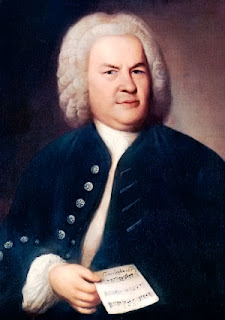
Happy 325 Birthday, Bach!

J. S. Bach

Johann Sebastian Bach was born on March 21st 1685. His father was a higher-ranking musician and his family was well-known for their musical talents. His father taught him to play the violin and harpsichord, and his uncle introduced him to the organ.

Youth

At the young age of nine, Johann became an orphan when his mother died, and shortly thereafter his father also passed away. Johann Sebastian went to live with his brother, Johann Christoph, who was an organist. Here, Johann Sebastian began a formal study of the organ.

Teenager

At he age of fifteen, Johann Sebastian Bach and a friend traveled to Lüneburg, where Johann sang in the Mattins Choir, played violin at the Court of Celle, and had the opportunity to study some of the best examples of German church music in his school's large music library. He was exposed to French music at this time, and it is believed that he also studied under organist Georg Böhm.

Less than three years later, he sought a post as an organist at a church that was currently under construction in Arnstadt, near Sangerhausen. While awaiting the completion of this organ, he played the violin in a small chamber orchestra of Duke Johann Ernstand in Weimer. Here he was exposed to Italian music. At the end of 1703, Bach received his post as organist at the age of 18. His organ had two manuals and 23 speaking stops.

Young Adult

In October of 1705, Bach took a leave of absence to hear the organist Dietrich Buxtehude. He was so impressed with this organist that he greatly overstayed his approved leave of absence in order to listen and learn from this master. When Bach did return to his post, he employed these new virtuoso techniques which confused his congregation, much to the chagrin of his employers. He was further reprimanded when he refused to work with a boys' choir he was asked to train, and when he was caught entertaining a young lady in the church. Amid this unrest, Bach learned of the death of an organist in a town with a rich musical history. He applied for the job and was hired on very favorable terms.

Early Married Life

It was here, in Mühlhausen, where Bach married his second cousin, Maria Barbara, in October 1707, and began composing vocal church music with much success. After just a year, Bach began looking for a more promising position.

He returned to Weimar where, as member of the chamber orchestra and as organist to the Court, his position paid double the salary of his previous post. Soon after his arrival his daughter, Catharina Dorothea, was born. Most of Bach's major organ compositions stem from this period, and he quickly became known as one of the best German organists.

In 1717 a feud broke out among the Dukes in Weimar. Bach was consequently passed over for a promotion, ended up in prison for a month (where he wrote the 'Orgelbüchlein'), and was dismissed from his post "without honor," in order to take the position of Capellmeister in Köthen.

Joy and Tragedy

The position of Capellmeister was the highest rank given to a musician during the baroque age. Bach's employer was a Calvinist, so religious music was non-existent. However, his master enjoyed secular cantatas and instrumental music featuring the latest styles and fashions from throughout Europe, and spent a great deal of money on his "band." Here Bach wrote much of his chamber music and enjoyed a stress-free time filled with music.

Unfortunately, upon returning home from a journey in 1720, Bach learned that his wife had died and was buried in his absence, leaving behind his four living children (in addition to three children who had died in infancy).

Bach continued with his work and in December 1721, he married soprano Anna Magdalena, she at the age of 20, and he 36. In the twenty-eight years of happy marriage that followed, thirteen additional children were born to the Bach family, though few of them survived through childhood.

One year after Bach's happy marriage his employer also married, but his wife was very anti-music. Bach soon sought employment elsewhere.

Bach's final city

Bach moved to Leipzig on May 22, 1723, where for the remaining 27 years of his life he was to live and work as Cantor, or Directore Chori Musici Lipsiensis - Director of Choir and Music in Leipzig. Bach was their third choice, after Georg Philipp Telemann and Christoph Graupner both refused the post.

Bach and his family lived at the school of St Thomas, where Bach was responsible for organizing the music in the four principal churches of Leipzig; forming choirs for these churches from the 54 pupils of the Thomasschule; and instructing the more musically talented boys in instrument playing.

Bach eventually became dissatisfied with his low-paying position, and in 1730 aired his grievances to the Leipzig city council. He longed to escape the 'trouble, envy and persecution' he experienced in Leipzig. Fortunately, in 1729 he took over the direction of the Collegium Musicum (Music Society), a secular orchestra of students and professional musicians founded by Telemann in 1702, where he often performed with his sons. Changes at the school also alleviated some of his concerns.

Later years

Bach was able to become slightly entrepreneurial in a society where musicians were often treated as slaves. In his later years he entertained visiting musicians from Germany and beyond; became a member of the Mitzler society; revised many of his earlier works; composed he Mass in b minor, the Canonic Variations, the Goldberg Variations, and The Art of the Fugue; among many other endeavors.

Eventually his eyesight began to fail him, and he composed his last chorale fantasia, based on the chorale "Before Thy Throne O Lord I Stand".

Johann Sebastian Bach died the evening of the 28th of July, 1750, after suffering a stroke and severe fever. He was buried in St John's Cemetery in an unmarked grave.

In conclusion

According to Wikipedia, "Bach's abilities as an organist were highly respected throughout Europe during his lifetime, although he was not widely recognised as a great composer until a revival of interest and performances of his music in the first half of the 19th century. He is now regarded as the supreme composer of the Baroque, and as one of the greatest of all time."

Happy birthday, Bach.

You may also be interested in reviewing Bach's Life in Pictures.

Monday, March 22, 2010

Lesson 11: Prelude Registration

Click here for Lesson 10: More Techniques in Hymns

We're still dealing with the stomach bug here, and on top of it, I've sprained my ankle! I had planned on discussing prelude registration this week, and when I saw that Dr. Cook has added a new handout to his free packet that went along with this topic, I wanted to share it with you.

I've often referred my readers to The New LDS Organist, a free course of 12 audio lessons developed by Don Cook. Just recently a new handout was added to the packet, which I'd like to share here. To read the packet on the website, click here.


Registration Suggestions for Prelude/Postlude Music
by Don Cook

Careful selection and proper performance of music can greatly enhance the spirit of worship....
Quiet prelude and postlude music creates an atmosphere of worship that invites the Spirit into Church meetings. The organist or pianist usually plays hymns or other appropriate music for five to ten minutes before and after a meeting.
--Music section of the Church Handbook of Instructions, p. 289

To build a stop combination for a prelude or postlude that accomplishes the purposes described above, first identify these important characteristics in the music. If these are not indicated in the score,
make the decision yourself:

1. MOOD: Meditative or jubilant? Use more words that describe the mood or sound more precisely (light or heavy, clear or rich, sparkling or foundational, simple, calm, reverent, ethereal, solid,majestic, quietly jubilant, etc.)
2. VOLUME: Overall volume level (very soft, soft, medium, etc.)
3. SOLO: Will a solo and an accompaniment be played on two separate manuals (solo and accompaniment registration), or will both hands play on the same manual (chorus registration)?

Next, decide on the sound that you want and find it on the organ.

CHORUS REGISTRATION

For “chorus-type” registration, in which both hands play on the same manual, try the combinations given below. Use the handout “Common Stop Names Listed by Pipe Category and Family of Organ Tone” to find particular flutes, principals, strings, reeds, or hybrids (as indicated below) on your organ. The following list begins with the softer stops or combinations, which are usually most effective in enhancing the spirit of worship:

1. a soft 8’ stop alone (flute, hybrid, or string)
2. the celeste effect (use two 8’ stops [hybrid, flute, or string, with celeste], or a single celeste stop marked “II” [like Gemshorn Celeste II 8’])
3. two soft 8’ stops (flute and hybrid, flute and string)
4. flutes 8’ and 4’
5. two soft 8’ stops and flute 4’
6. flutes 8’, 4’, and 2’ (or flute 8’, principal 4’, and flute 2’)
7. principal 8’ alone
8. principal 8’ and flute 4’, or flute 8’ and principal 4’
9. principals 8’ and 4’
10. principal 8’ plus no. 1, 3, 4, 5, or 6 above
11. principals 8’ and 4’ plus no. 1, 3, 4, 5, or 6 above
12. principals 8’, 4’, and 2’ (note the brightness of the 2’ principal)
13. Adding the chorus mixtures and/or chorus reeds probably reach beyond an appropriate volume level for preludes and most postludes in Sacrament meeting.

SOLO AND ACCOMPANIMENT REGISTRATION

For “solo and accompaniment” registration, one hand (usually the right) plays the solo part on either the Swell or the Great, and the other hand (usually the left) plays the accompaniment on the remaining manual. First, decide whether the sound of the solo or the accompaniment is most important to you, and begin building that combination. Next, build the other combination, balancing it with the first. For the accompaniment (usually played by the left hand), use one of the chorus-type registrations given above.

For the solo part (usually played by the right hand), you need only find a more prominent (louder) stop or combination. The solo may be registered with any chorus-type registration (see above), as long as the accompaniment is softer. Celeste effects, however, are usually most effective in the accompaniment part. The following is a list of solo stops or combinations that are not included in the chorus registrations given above. These usually result in a more colorful solo:

1. a single harmonic flute 8’
2. flutes 8’ and 2’ (a “gap” combination)
3. combinations of the 8’ flute and other stops from the Cornet (pronounced “cor-NAY”):
a. flutes 8’ and 2 2/3’ (an especially effective soft solo combination)
b. flutes 8’, 4’, and 2 2/3’
c. flutes 8’, 2 2/3’, and 1 3/5’ (“Sesquialtera”)
d. flutes 8’, 4’, 2 2/3’, and 1 3/5’
e. flutes 8’, 4’, 2 2/3’, 2’, and 1 3/5’ (the full Cornet)
4. string 8’ (may sound like a soft reed)
5. flute 4’
6. soft reed 8’ (Oboe, Cromorne, Clarinet, French horn, English horn, Schalmei)
7. soft reed 8’ “rounded out” with other mild 8’ and 4’ stops (flutes, hybrids, strings)
8. all the 8’ stops on the Great that blend, possibly including the Swell to Great coupler (a very warm, “singing” solo combination)
9. a larger chorus reed 8’ (Trompette, Fagott) (more effective as a meditative solo stop when played in the tenor range)
10. a larger chorus reed 8’ “rounded out” with other 8’ and 4’ stops

PEDAL BALANCE

Build the bass part to balance with the chorus-type combination (not the solo). Choose a soft 16’ and 8’ stop from the Pedal division (Subbass, Bourdon, Gedackt, Lieblich Gedackt). As an alternative, select a soft 16’ Pedal stop and Swell to Pedal or Great to Pedal (whichever does not have the solo). To balance larger manual combinations, add larger 16’ stops followed by 8’ stops in the Pedal as needed. If manual-to-pedal couplers are used, the 8’ balance will occur automatically as manual stops are added.

Write down the combination or save it to memory for later use.

Once you have selected the combination that you want, write down the stops in pencil on the music. You can then draw this combination by hand whenever you play that piece on that organ—if you have time. If you will not have time to draw the stops by hand, set the combination on a combination piston (“preset”) as described in Lesson 1 under the combination action. Be sure to double-check your preset just before the meeting!


Homework

Using Hymns Made Easy, pick one or more hymns to practice Solo and Accompaniment prelude/postlude registration with, as mentioned in this article. Remember to play the melody on one manual and the accompaniment on another, balancing the pedal appropriately.

Register the hymns we learned in lessons 9 and 10: "God Moves in a Mysterious Way" and "Truth Eternal," for chorus prelude/postlude registration.

In Conclusion

I hope you found Dr. Cook's information helpful. Proper registration during prelude and postlude is essential to church meetings. Appropriate prelude invites reflection and helps members feel the Spirit prior to the meeting. Appropriate postlude mirrors the mood of the meeting and allows members to feel that Spirit as they leave the chapel.

Click here to continue on to Lesson 12: Prelude and Postlude .

Sunday, March 21, 2010

Sunday Song: Bach's C minor Fugue BWV 537

In honor of J.S. Bach's 325th birthday this month, the Sunday Songs will highlight a few of his works.

An unnamed organist playing C minor Fugue on Saint-Sulpice's Cavaillé-Coll organ, one of the biggest instruments in France.

Since the microphone is so close to the console, you can hear the organ as the organist hears it, with the noise from the Barker Machines and trackers.

Thursday, March 18, 2010

Guest Article: Allen AP-22a compared to AP16

Today's article is a guest article written by Barry Holben, Vice President of Sales for the Allen Organ Company.

Barry Holben

Thanks for your e-mail and the invitation to supply your readers information about the Allen Ap-22a. I’ve attached some documentation about the AP-22a and comparative statistics for its predecessor, the AP-16. As you will see, the stop list of the AP-22a is significantly larger than the stop list of the AP-16. Beyond the resident stop list of the AP-22a, there are two unique features that provide further versatility to this instrument. The first of these is “2nd Voices”. Many of the primary voices have counterparts that can be invoked through the 2nd voices control located in the “Generals” portion of the stop rail. Additionally, the AP-22a has an entire second stop list, accessible through the instrument’s Console Controller, the user interface located on the left side of the key desk. Using the Console Controller, the organist can invoke a complete French Romantic stop list. This specification has fiery reeds and large-scale of the principal stops. The AP-22a also features a Hymn Player that includes many favorite LDS hymns. Many Wards and Stakes value this feature for occasions when organists are unavailable.

In addition to the versatility provided by the features listed above, the AP-22a also features Acoustic Portrait™, the only sampled reverb system available in any digital organ. This unique patented system provides the actual acoustics of a wide range of real-world environments from cavernous French cathedrals to the short reflections of pipe organ chambers. With Acoustic Portrait, organists can choose the acoustic that best enhances the organ’s environment and compliments the style of music being performed.

I hope this information is interesting to you and your readers.


Mr. Holben, thank you so much for sharing this valuable information with us!

I'd like to take this opportunity to share two videos of our honored guest playing his own arrangements. Enjoy!


Monday, March 15, 2010

Lesson 10: More Techniques in Hymns

Click here for Lesson 9: Playing Your First Hymn

I apologize for the lack of pictures and videos this week. We have an unwelcome stomach bug running through our house! I'll try to add them at a future date.

This lesson we will study hymn number 4, "Truth Eternal." This hymn is short, but has a lot of technique packed into its eight measures. Again, we will be using Carol Dean's Hymns from the L.D.S. Hymnal Marked for the Organ (my copy is the 1996 version--yours may be slightly different). If you need a copy, email her at carolorg1111(at)gmail(dot)com for more information. me at ldsorganistblog at gmail dot com for more information.

Pedaling

The pedal part of this hymn is fairly straight forward. When playing, remember to keep your ankles together for intervals through a fourth and your knees together for intervals through an octave.

Prelocate notes. For example in measure 1, play the D, E, F#, F# with the left foot. As soon as the right foot plays the G, prelocate the D with your left foot so that it is ready for beat 3. As soon as the left foot plays that D, prelocate the A with the right foot (it's just one note higher than the G). When the left foot plays D, the right foot's heel can cozy up to the arch and feel the E that is played on beat 2 of measure 4. Continue in this manner throughout the rest of the song. Prelocating is key in playing the pedals.

Feel free to review Lesson 6 if you need a refresher. Work slowly, keep a good legato technique throughout, lifting in rhythm for an eighth rest when the notes repeat. Using a metronome is a very good idea.

Common tones and repeated notes

In measure 2 the soprano D is followed by a D in the alto. Since the melody needs to remain unbroken, that D needs to be tied, then lifted and repeated for beat 3.

In measure 6, the D in the alto is followed by a D in the tenor. A general rule to follow here is that when a note changes from the alto voice to the same note in the tenor voice, break the notes (but when the reverse is true--tenor to alto--tie the notes).

There are a couple of places in the song where tying notes will contribute to a smooth legato. In measure 1, beat 3 is strong and 4 is weak, three of the four notes repeat, so tying the D is an option. (When the hymn is fast one part needs to connect. In slower hymns it's better to have two notes carry through.)

In measure 7 from beat 3 to 4 the exact same notes are being played, so again tying the D makes sense.

Fingering

Through redistribution of the inner part, much of this hymn can be played with direct fingering. In the right hand, measure 3 is the only measure that is tricky--with finger crossing and a finger substitution. In finger substitution, one finger is replaced by another during the same note so that the first finger is free to play another note. The C# is played with the fourth finger, then the 5th finger is substituted so that fingers 4 and 2 can play the B and F# in measure 4.

The left hand has two finger glissandos in measures 5 and 6 and a finger crossing in measure 8. Remember: the finger or thumb slides from one note to another, from a black key to a white key in rhythm without breaking legato.

Learning the Hymn

Take a minute to read the text and decide where the breaks should and should not be. See Breathing for more information. Mark the hymn accordingly. Now let's use the 15-step method that we discussed last lesson.

1--Begin with just the soprano line. Use proper fingering, crossing, substitution, and breaks for the text.

2--Now play just the alto part, using the left and right hands according the redistribution of the alto part, tying the Ds as mentioned above.

3--The tenor part is next. Practice the glissandos until they are flawless.

4--Learn just the pedals. In measure 3 there's a minor 3rd that might be tricky. Practice prelocating--especially the A in measure 8 several beats before it's time to play it.

5--Play the soprano and bass lines together.

6--Play the soprano and tenor lines together.

7--Play the alto and tenor lines together, remembering to redistribute the alto part where indicated.

8--Play the soprano and alto lines together, again redistributing the alto part as needed.

9--Play the alto and bass lines together, again redistributing as needed.

10--Play the tenor and bass lines together. This is one of the most difficult combinations to play.

11--Play the soprano, alto, and bass lines together, redistributing as needed.

12--Play all the manuals together--the soprano, alto, and tenor lines.

13--Play the soprano, tenor, and bass lines.

14--Play the alto, tenor, and bass lines.

15--Play all four parts together very slowly with a metronome, then gradually increase the tempo until you reach your desired tempo. Do not play faster than you can play perfectly.

Homework

Using the 15-step method, learn to play hymn number 4, "Truth Eternal," at tempo. Read through the text and, using the Breathing article, decide how you'd like to follow the text of each verse of this hymn and practice accordingly.

Once the hymn is learned, choose your registrations for congregational accompaniment. Include registration changes between verses. Practice the hymn with these registrations changes. Work to ensure they are smooth, effortless, and in tempo.

If you have someone available who leads music, practice following them as they lead and sing as if you were playing for a congregation.

In Conclusion

Now that you've learned two simple hymns, it's time to discuss prelude and postlude pieces. In the next two lessons we'll discuss these important aspects of Sunday worship. Then we'll delve into playing slightly more complex hymns.

Continue on to Lesson 11: Prelude Registration.