Welcome to The Latter-day Saint Organist's Resource Blog

The purpose of this blog is to help pianists learn to become true organists. Many individuals believe that if you play the piano you can play the organ, but the instruments differ greatly. While this blog is specifically geared towards members of The Church of Jesus Christ of Latter-day Saints, much of the information shared can be utilized by all. I hope that the information I share here will help you become an effective organist in your ward, stake, or other congregation.

Feel free to browse and search this blog. It was started in January 2010 and while new posts aren't added very often, this blog contains a wealth of information and is a wonderful resource for all organists. If you're a new reader, you can find the first lesson here: Before We Begin: Acquiring the Essentials. Also, please "like" the corresponding facebook page, which is updated more often. A link is provided on the right sidebar, or you can click here.

Thanks for visiting!

Tuesday, August 4, 2015

BYU Organ Workshop Notes and Pictures


Are you following this blog on the facebook page?  If not, you're missing out on so much!  Check it out today for pictures and notes from the BYU Organ Workshop!

Tuesday, June 30, 2015

Extra Time to Fill After the Sacrament Hymn?


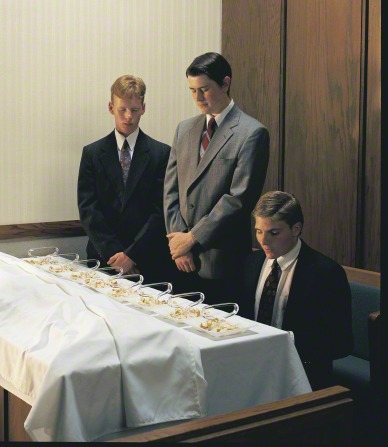
The sacrament hymn is an integral part of preparing the congregation to take the sacrament and renew sacred covenants. This portion of our sacrament meeting is very sacred--in fact, it is the very reason we hold sacrament meetings.  As organists we have the privilege to help prepare our congregations for this hallowed ordinance.

Sometimes, the sacrament hymn is concluded before the priests have finished breaking bread. When this happens, what should the organist do?

The most common practice in this situation is for the organist to continue playing until the priests are finished breaking bread.  While your Bishop may request for it to be handled differently (always follow the counsel given by your priesthood leader), if you are expected to play during this time, what do you do? How can you best invite the spirit and solidify the message of the sacrament hymn?

There are some sacrament hymns which almost always end before the bread is broken, such as hymn #184, Upon the Cross of Calvary. Then there are hymns such as #183, In Remembrance of Thy Suffering which seems to go on forever. Either way, it's good to have a plan for what you will do if you need to continue playing after the verses are sung.

Sing All the Verses

My first recommendation is: If there are additional verses printed underneath the music, talk to your Bishop about having the congregation sing them!  I remember how disappointed I was in my previous (very large) ward, when we finished singing three verses of hymn #187 God Loves Us, So He Sent His Son and the priests were still breaking bread. The organist continued playing the hymn through twice--the same number of verses that were printed below the music.  We could have continued singing the beautiful text that followed! The very last couplet is my favorite:
In word and deed he doth require
My will to his, like son to sire,
Be made to bend, and I, as son,
Learn conduct from the Holy One.

This sacrament doth represent
His blood and body for me spent.
Partaking now is deed for word
That I remember him, my Lord.
If there are additional verses, my recommendation is to sing them!  Fortunately, I have a Bishop who (while not a musician himself) loves music, and recognizes the value of singing all the verses, something that is encouraged in the "Using the Hymnbook" section of the hymnal.

If there are no additional verses, or if your Bishop does not want to sing them, what can you do?

Make a Plan

 As the sacrament hymn ends, the organist has to make a judgment call on the spur of the moment:  Are the priests finished breaking bread? How much longer will it take before they're done?  Is there time to play the entire hymn again or not? Sometimes, the organist will play the first chord of the hymn, and the priests will sit down.  Or the organist will think the priests are going to finish up any second, and then the priests continue to break bread for another long minute in silence.  Having a flexible plan can help with this transition, and subtly allow the congregation to review in their minds the words they just sang.

 1. What registration are you going to use? Your registration for the post verse should be different in volume and color from the congregational accompaniment registration. Please don't continue playing with the same registration on full volume! This registration should be very reflective, subdued, and allow for reverent preparation, similar to what you would hear in the temple chapel.  I've set a couple of my divisional pistons (the pistons that only affect the great, pedal, or swell manuals) specifically for additional sacrament time.  For example on all three #1 pistons, I have a soft solo registration on the swell, a very soft string celeste on the great, and a soft pedal 16' and 8'.  I can quickly use my hands and feet to select all three #1s and begin playing an additional verse immediately following the final verse of the hymn when needed.  I also set all three #3s as a contrast when needed.

2. What are you going to play?  Can you lengthen or shorten it? Mike Carson has a wonderful fughetta for hymn #184 that does not call attention to itself and works very well in this instance.  I use it almost every time we sing that hymn.  You can email him at mcarson [at] digis [dot] net to request a copy.  Daniel E. Gawthrop has a simple, appropriate arrangement of Jesus, Once of Humble Birth (titled "Deliverance") available on wardorganist.com that I use on occasion.  I've also taken an arrangement of There Is a Green Hill Far Away from Hymns Made Easy and transposed it to the key in the hymnal to play during this extra time, adding appropriate pedal notes throughout. If you are going to use an arrangement ask yourself: "Does this arrangement call attention to itself? Is it simple and humble?  Does it allow for reflection?  Is it in the same key as the hymnal?  Can it be shortened as necessary? Does it 'feel' right this week?" Remember, as organists we need to use this time to solidify the message of the hymn in the hearts and minds of the congregation, and to provide time for reverent preparation. Many times I will just use a soft registration and play through the hymn again, the last line of the hymn again, or I will solo out the soprano line on the swell, play the alto and tenor notes on the great, and play the bass notes in the pedals.

3. What will you do if the priests sit down right as you start to play? Do NOT stop after one note!  Play a short phrase that resolves and feels intentional. Music deserves to be present, and not be an afterthought.  Don't play the entire hymn through, unless your Bishop wants you to, but make sure your playing is intentional and reflective.  Figure out in advance how to play as little as possible to still make your playing feel complete, giving an "Amen" to what has been sung.

4. What if you stop too early? This past Sunday, I played an entire post verse for hymn #173 While of These Emblems We Partake, and one priest was still breaking bread.  Assuming he would quickly finish, I repeated the last phrase, and he was still going!  It would have sounded "wrong" for me to play something else at that point, so I stopped and allowed for some silence as he finished.  Don't feel like you have to continue playing if your preparations were too short, or if you misjudged the amount of time it would take for them to finish.  It's better to allow for silence than to detract from the spirit by scrambling to fill that time, or beginning again after stopping.

5. How are you going to lower your volume?  I've found that when I am sensitive to the organ's volume level, and take the volume down significantly for these post verses, the congregation audibly quiets, the spirit intensifies, and everyone is better prepared to partake of the sacrament. How are you going to accomplish this volume change?  Practice your plan!  Will you close your expression pedals?  Will you make the volume change solely through a registration change? Will you do both at once?  Make sure you are comfortable with the method you choose, and make sure you can make the change very quickly and seamlessly!

Always Remember

Remember, you are preparing the congregation to participate in the sacred ordinance of the sacrament. 

Remember, your Bishop has stewardship over how this extra time is handled.

Remember to prepare with the Spirit, "which showeth all things, and teacheth the peaceable things of the kingdom" (Doctrine and Covenants 39:6).

Remember, as we partake of the sacrament we promise to always remember our Savior.  Remember Him as you prepare to prepare your congregation to participate in this sacred ordinance.


Thanks for reading!


You may also be interested in this article: Real Life: Continuing to play after the sacrament hymn is over

Friday, February 27, 2015

Watch that volume, even if it's a funeral!

The purpose of this blog is to help organists learn and grow so they can better fulfill their calling and magnify their opportunity to play for worship services. As such, when my personal experiences bring suggestions to mind, I like to share them here, so that we can all learn from each other.

I had the opportunity to attend the funeral service for my uncle this morning. It was an emotional occasion, but one that brought a lot of my extended family together for a treasured reunion.

The funeral was held in a beautiful, old mortuary.  The chapel was quite narrow, but very long.  I ended up sitting near the back with my brother, a couple of my aunts and their husbands.  As we took our seats, just prior to the beginning of the funeral, I mentioned that I couldn't hear the organ prelude music from our seats.  My aunt commented that she couldn't even hear the organ as we entered, near the front of the chapel. I considered letting the organist (a stranger to me) know, but there wasn't time before the family entered.

Lesson #1 from today: While a subdued organ prelude is very appropriate for a funeral, make sure your organ playing can be heard! If you are playing in an unfamiliar space, it is a very good idea to ask someone to be your ears, and let you know how the organ sounds from the rear portion of the space.

When the introduction began for the opening hymn, I was a bit concerned, as the organ was again very underpowered from where I was sitting.  This concern was well founded, as the rear of the chapel finished the hymn a good six to eight beats behind the front of the chapel--and the organist twisted in her seat to watch us finish singing the first verse.

Lesson #2 from today: If the people in the rear of the chapel are singing significantly behind those in the front, it probably means they can't hear the organ adequately.  If this happens to you, try increasing the volume by opening the expression pedals or adding stops for the next verse.  Remember: Even congregational hymns for funerals need to be supported with adequate organ volume, especially if you do not have a music director. Fortunately, we did, so we had to rely on our eyes instead of our ears for the remaining verses and hymn (the closing hymn was equally soft).

It was a wonderful funeral, and while the lack of organ volume didn't detract from the service, it did inspire me to share this experience with my readers.

Organ volume is very, very difficult, if not impossible, to determine from the console. If your electronic organ has both console and external speakers, turning the console speakers off (there is usually a stop tab that does this) can help you get a better feel for the volume in the room.  However, nothing works better than another set of ears providing feedback.  And remember--the volume in an empty chapel will be louder than in a chapel full of people, who absorb the sound.

The buddy system isn't just for field trips--give it a try!

Thanks for reading.

BYU Organ Workshop Registration for 2015

Registration is now open for the 2015 BYU Organ Workshop.  Register before March 2nd for the best price!

http://ce.byu.edu/cw/organ/index.php

Wednesday, March 12, 2014

13th Annual BYU Organ Workshop


In the past, I've shared how wonderful this workshop is.  I believe that it is invaluable to organists of all levels.  I highly encourage my readers to attend!  Plus, this year participants will also have the opportunity to play a Temple Square organ on Wednesday evening.

If you register before April 4th, you'll receive an Early Bird Discount, so don't delay!


Tuesday, February 4, 2014

Such a Time As This

The following article, which I wrote, appeared in the February 2014 Newsletter of the Utah Valley Chapter of the American Guild of Organists.

Almost two years ago I had the wonderful opportunity to play for BYU Women's Conference. I was ecstatic as I prepared. Ideas flowed, and I ended up incorporating an assortment of creative techniques into the hymns. After many organ commitments in the ten days leading up to the conference, which included an unexpected family funeral, I was overwhelmed and felt the pressure of the world on my shoulders. During my practice the night before I was to play, things completely fell apart and I had to accept the fact that due to my exhaustion, my practicing was now complete, for better or worse.

The next morning, while sitting with friends during the opening session of the second day of Women's Conference, I felt so nervous and began to second-guess myself; none of the other organists had utilized creative hymn techniques, was I looking beyond the mark? As they announced the closing session, my friend turned to me and said, “Just think: You get to play for an apostle of the Lord. An apostle will sing to your music!” Her statement opened my eyes and allowed me to see things a little differently, yet I still felt inadequate. I still questioned my choices—did I really want to solo out the alto on that chorus? Did I want to add the end of phrase elaborations on that verse? I didn't know how to let go of my stresses and let the Lord in.

In the minutes before the closing session, I again pondered on what my friend had pointed out, and my purpose was finally made known to me. I realized I was there to help bring the Spirit to the meeting and prepare those in attendance to hear the message of an Apostle of the Lord. This purpose was not only my privilege, but my great responsibility. I had been led to choose that session; to incorporate techniques that would paint the hymn text and unlock the power of these hymns. When I considered simplifying the accompaniment by not playing my additional material, I had the distinct impression that I was to play as I had prepared. I knew that God was in control, and that I was just a part of His plan. As long as I remained humble, things would go as they should.

Mordecai's statement to Esther played through my head, “And who knoweth whether thou art come...for such a time as this.” The weight of the world left me, and the peace of God replaced it.

While my playing was not flawless, it was powerful, and I received confirmation that it was an acceptable offering. I was where I needed to be, I had listened to the Spirit and accomplished God's purposes. He chose me for “such a time as this,” just as He has chosen each of us in our own sphere.

Every single time we play we are in a position to lift a burden, heal a broken spirit, comfort the weary, and bring joy and rejoicing to a happy heart! “Who knoweth whether thou art come...for such a time as this” in the lives of those who hear you play? We may never know the impact of our preparation, but we should never doubt our important role in the lives of others.

Saturday, November 30, 2013

Real Life: Playing After a Break

I received this question from Paul:
I play for my ward and am having some problems.  I practice the hymns and do alright for the opening and sacrament hymns.  However, the problems come when I play the intermediate and closing hymns.  I sometimes stumble thru the first few notes.  By the end of the 1st verse I am doing fine.  My organ teacher says I should just play the manuals at first.

How do you get your head into playing after having to resting?  do you have any suggestions?

I think you are experiencing a common problem for organists.  I do have several suggestions that might help.

Write in Fingerings

The first is simply to make sure you use the same fingerings every time you play a piece.  Write them in and be consistent.  Muscle memory is so important to playing.  If you use the same fingerings every time you play, you will be more likely to play without mistakes.

Practice For Your Situation

This is the suggestion that came to my mind as soon as I read your email. If you are struggling with an aspect of playing, you need to practice that aspect.  In this case, you need to approach the organ "cold" and play the piece that you will play after a break.  As many times as possible, approach an organ, play the introduction and all the verses of the hymn through, then walk away.  This method is easier if you have a home organ.

If you do not have regular access to an organ in your home, or if your chapel is some distance from your house this can be difficult, but can be adapted.  When you practice, start your practice with an intermediate or closing hymn. In the middle of your practice session, take a break and walk around the building, use the restroom, get a drink, then return and play your problem hymn again.

You'll soon find playing after a break becomes easier.

Take a Moment to Think 

When you do approach the organ after a break in the service, take a moment to review the piece in your mind before beginning to play.  It's much better to delay the introduction a few seconds than to start before you are mentally ready.

Also, if it is an issue for you, get the brain out of the way.  Remember that your role is to facilitate worship, and that you are playing for the glory of God.  Try to make your playing be about Him, not you.  Ask for His help, and you will receive it.

Simplify the Introduction

Finally, if you would feel more comfortable, you can simplify the introduction using these techniques, and perhaps prolong it.  By the time the congregation begins singing, you should be sufficiently warmed up to play the hymn as you have practiced it.


I  believe by following these suggestions, you will soon come to the point where you play without stumbling, even after a long break.

Thanks for reading!  I hope these suggestions help.