Welcome to The Latter-day Saint Organist's Resource Blog

The purpose of this blog is to help pianists learn to become true organists. Many individuals believe that if you play the piano you can play the organ, but the instruments differ greatly. While this blog is specifically geared towards members of The Church of Jesus Christ of Latter-day Saints, much of the information shared can be utilized by all. I hope that the information I share here will help you become an effective organist in your ward, stake, or other congregation.

Feel free to browse and search this blog. It was started in January 2010 and while new posts aren't added very often, this blog contains a wealth of information and is a wonderful resource for all organists. If you're a new reader, you can find the first lesson here: Before We Begin: Acquiring the Essentials. Also, please "like" the corresponding facebook page, which is updated more often. A link is provided on the right sidebar, or you can click here.

Thanks for visiting!
Showing posts with label guest post. Show all posts

Friday, October 26, 2018

White Organ Shoes for Men

Update

Please note: Unfortunately, TicTacToes has gone out of business.

Original Article Follows

Max Walker, the sub-dean of the Salt Lake Chapter of the American Guild of Organists has shared information on how to obtain white organ shoes for men. I wanted to pass this information on to you, as I know many men end up playing in their stocking feet because they're unable to find white organ shoes.

Photo composite by Jennifer Morgan
 Hi folks. This is for those gentlemen who may be playing chapel organ in LDS temples and wish to have white organ shoes. The same info can be applied to any color organ shoe. Many, many colors are available as noted below. Similar options exist for the women's style shoes, in case you ladies are having trouble finding white (colored) shoes.

Organmasters, the go-to source for many organists, doesn't sell the men's Oxford shoe in white and doesn't make it to order.

My new friend, Bill Hesterman, pointed me to TicTacToes.com. They sell dance shoes, and have a category of organ shoes. They are the factory, so they will make a shoe in white even if it is not offered on the web site in white; one simply needs to call to ask for what one needs. 

There are two shoes at TicTacToes that would be attractive you gentlemen in that case: 
  1. "Applause." The Applause is like Organmaster's Oxford. It is listed only in black on the web site, but can be made in white (or any of the many colors they offer). Note that the heel will be black regardless. If one finds that unsuitable, but wants that style, one can paint that heel or have the cobbler do it. The toe is slightly more pointed than the Oxford, but not unnaturally so. It's just a nice looking shoe. The heel is the same as the Organmaster Oxford: 1.25".
  2. "Cameron." The Cameron is listed under Specialty Organ Shoes. Its heel is made to match, wrapped in the same color leather. This shoe has no shank. Its advantage is the white heel. It looks normal enough viewed straight on. I have a pair on order, but haven't received it yet, so I cannot comment yet on the shankless fit. The Cameron comes with a taller heel than the Applause: a 1.75" "Latin" heel. It can be ordered with a 1.25" heel if you prefer that; simply specify upon ordering. 
Artist's rendering by Jennifer Morgan of white "Applause" organ shoe

 A couple more things to note: 
  • TicTacToes' shoes run true to US sizing. If you're accustomed to Organmaster shoes, do not trust that sizing will match; it will not. Organmasters run short to size, and are more snug.
  • The white shoe is made to order and cannot be returned. If you are skittish about sizing, TicTacToes suggests that you order the shoe in black, which is returnable, confirm sizing, then return the black and order the confirmed size in white. Obviously, you will confirm all of that when you order and won't rely on my account of their policies. 
  • Pay attention to heel length. These vary. You can specify what you are accustomed to.
  • Finally, these are not kept in stock and are usually made to order. Plan on extra time to receive your shoes; they suggest 4-6 weeks, but my first pair came at about 3 weeks.
Happy Organing!

Sunday, February 18, 2018

Sunday Song: Organ Fundamentals Training Video

Okay, so this isn't really a Sunday Song, but it is an old training video from 1972 with Tabernacle organist Alexander Shriner providing the introduction. The information shared is still very valuable. Enjoy!

Thursday, March 22, 2012

Guest post: Making organ slippers

On this blog I've shared the importance of proper organ shoes many times. The heel on the shoe facilitates playing notes with the heel and straddling natural keys. The heel also guards against the organist developing a "march fracture," which is also known as fatigue fracture or stress fracture of metatarsal bone. While worth the price, organ shoes can be somewhat expensive.

Sandra Dee Thomas

Sandra Dee Thomas has posted about her journey towards making an affordable alternative to organ shoes, which is a very novel idea. Now that she has perfected her pattern, she has graciously agreed to write a guest post for the blog. As Sandra says, "Shoes are best if you have the money. However, if you don't, or have tried the shoes and do not like them, the Organ Slippers are an alternative. They are a blend of both socks and shoes."

Thanks for sharing your efforts with us, Sandra!

(To view the pictures larger, just click on them.)


Organ Slippers
How to make them
By Sandra Dee Thomas

Making Organ Slippers

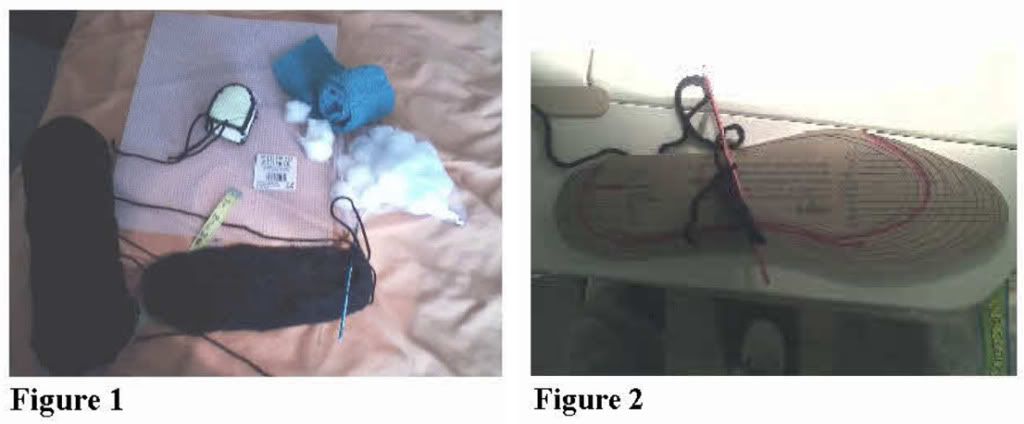
Materials:
1 skein of medium weight yarn (your choice of color)
Crochet hook: size E/4 or 3.50 mm
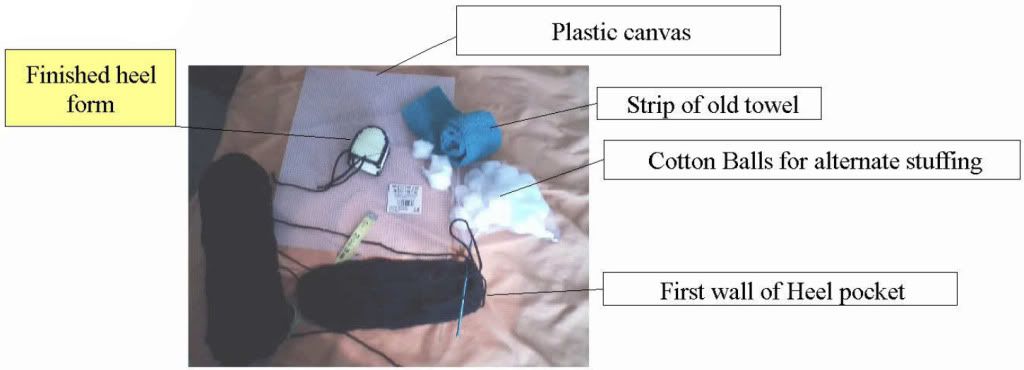
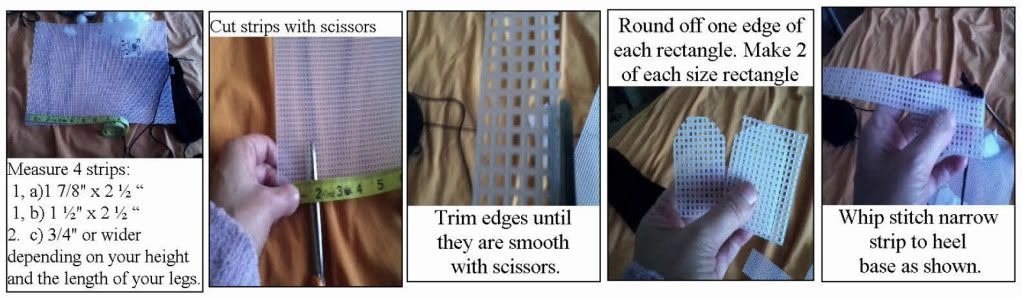
1 10.5"x13.5" sheet of Ultra Stiff Plastic Canvas
1 yarn needle
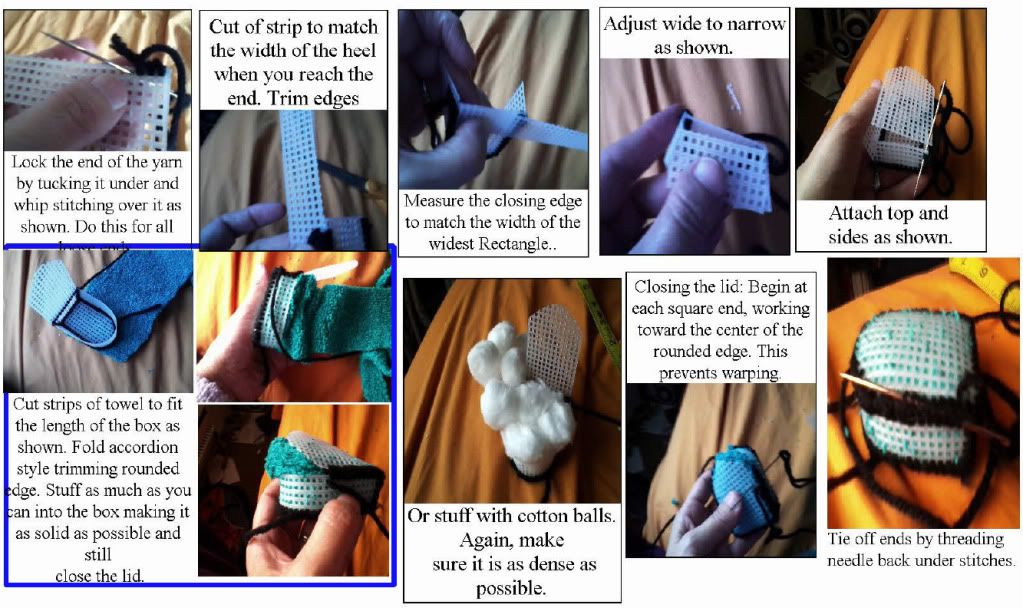
1 small bag of cotton balls or 3" strips of an old towel for stuffing heel form
1 pair of inexpensive shoe inserts for a guide in shoe sizing (trace out your size)
Materials

Overview:
If you can single and double crochet, you can easily make them. Everything is single crochet until you reach the second-to-the-last row in the top of the shoe (7th row). The 8th row is then double crocheted to make room for the adjusting string or shoe lace.

The key is to make sure they are snug on your feet so they do not shift.
By simply following the shape of the insole the slipper should fit just fine.

Making the Main slipper:
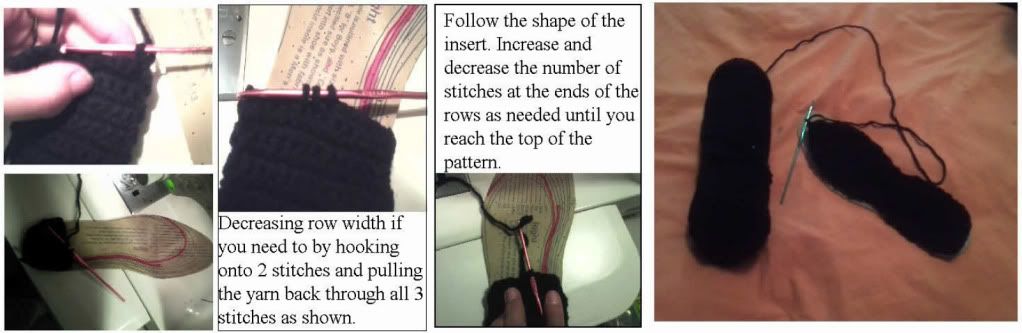
  1. Begin at the heel
    1. Chain 8 stitches.
    2. Turn and single crochet back through the first row of stitches.
    3. Increase one more stitch at the end of the row. Chain one and go back.
    4. Continue going back and forth, increasing one stitch at the end off each row until you reach 12 stitches.
    Figure 3
  2. Stop increasing the stitches in the rows. Crochet back and forth until you reach the ball of the foot.
  3. Step 2
  4. Beginning at one end of the last row, crochet back, pick up an extra stitch at the beginning of the second-to-the-last row, reverse. Continue in like manner until you have reached just past the joint of the foot.
  5. Step 3
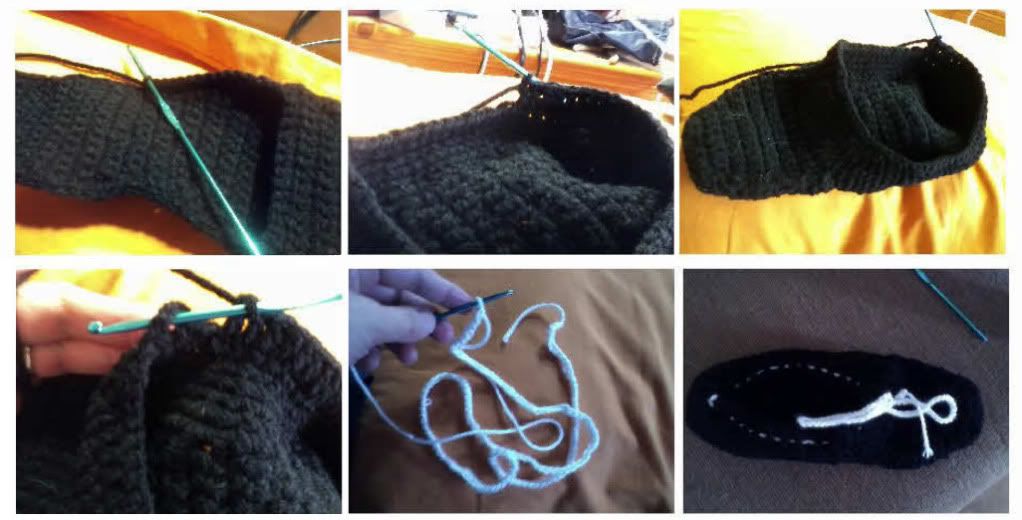
  6. Next, single crochet continuously all around the slipper, reducing stitches at the front as necessary for fit to form the sides of the slipper.
  7. Step 4
  8. Double crochet the next row. Single crochet one more row. Tie off. Make a string (125-150 single crochet) and loop it through the double crochet.
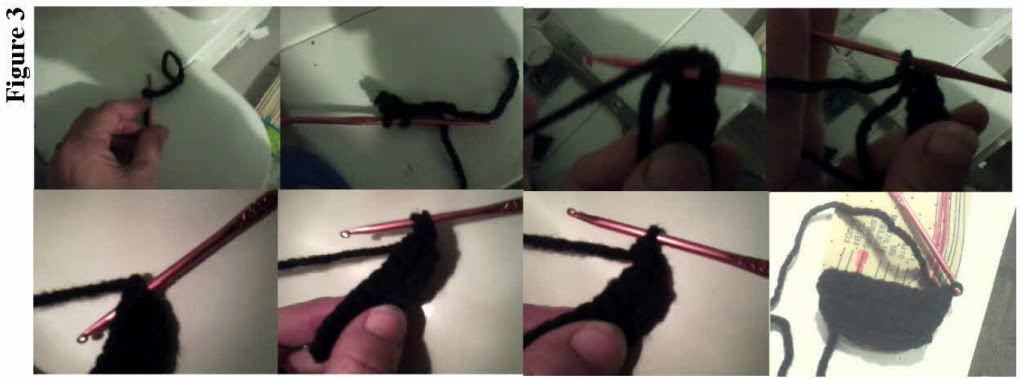
  9. Turn the slipper over and begin making the pocket for the heel. At this point you may want to stop and make the heel form so you can better shape the pocket to the heel form insert.

Heel Form Insert
Heel Form Insert 1
Heel form Insert 2
Heel Form 3

Heel Pocket

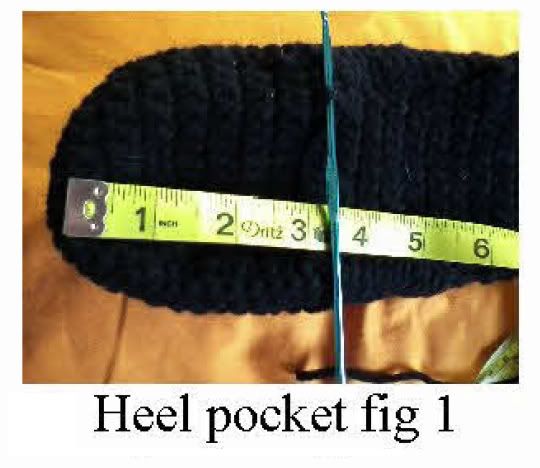
  1. Measure 3 1/2" from the back of the heel or tie the slipper onto your foot placing the crochet hook on the front edge of the ball of your heel. Hold. Insert the hook into one edge and start single crocheting around the back edge of the slipper.
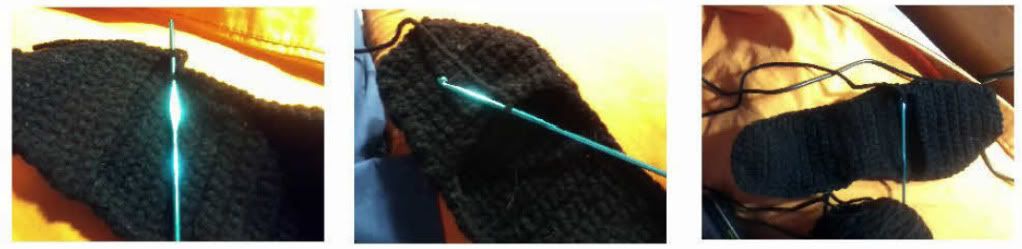
  2. Figure 1
  3. At this point, it would be a good idea to place the heel form on the slipper with the widest side next to the slipper so that you can have a guide as to how far toward the heel you need to make the pocket wall. Starting at where you first inserted the hook, you should go one row beyond 2 1/2".
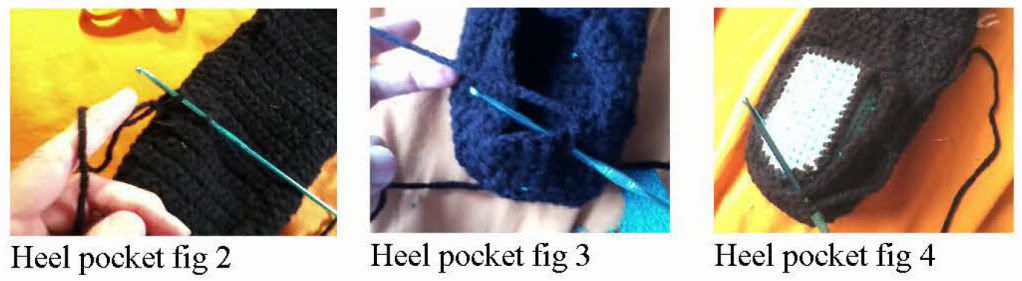
  4. Continue around the back of the slipper until you have made a "horse shoe" shape. Chain one and reverse back, building a wall that is one row over the top of the heel form. At this point, crochet down one edge of the wall and across the middle of the slipper to connect the two sides of the wall with a single row of crochet. Tie off. Cut yarn.
  5. Figures 2-4
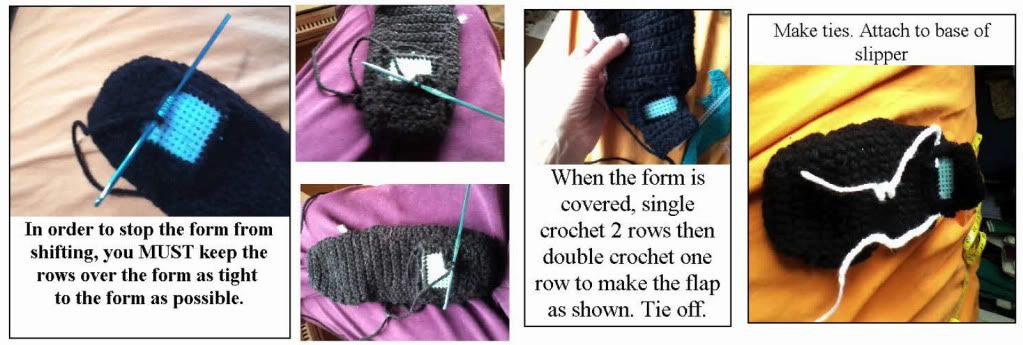
  6. To close the heel pocket, insert the hook into one back edge of the heel pocket wall as shown in figure 4. Using the form as a guide, crochet back and forth to cover the form.
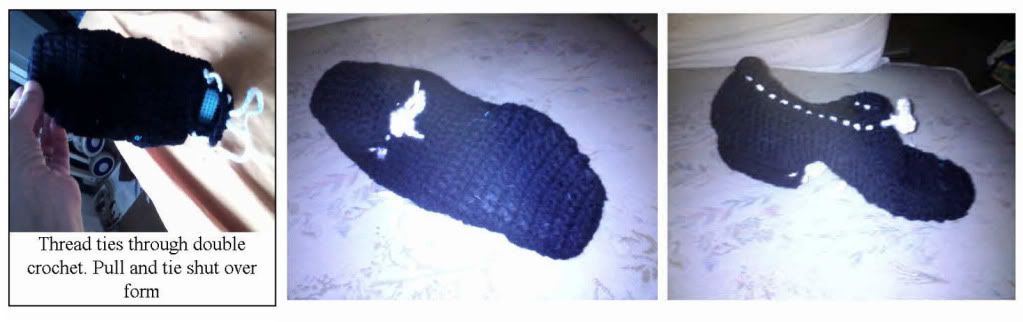
  7. Closing 1 Closing 2
    You are done! Now make the other one.


Sandra has also been working on a portable (silent) pedal board which can be used with pianos and small keyboards, and has promised to share that tutorial in the future. Thanks again, Sandra!

If you would like a .pdf copy of this information, you can email Sandra at SandraDeeSilva at yahoo dot com.

I welcome guest posts from my readers. If you have something you'd like to share, please contact me at ldsorganistblog at gmail dot com.

Thanks for reading!

Friday, August 6, 2010

BYU Organ Workshop Keynote Address 2005

I'm attending the BYU Organ Workshop this week. I can't wait to come back armed with new and wonderful material to share with you!

Since I'll be gone, I'm using this week to share past keynote addresses with you. Here is Dr. Richard L. Elliott's address from 2005, found here.


The Unified Organist

One of my most memorable experiences came while serving a mission in Argentina. I had been in the country for nearly a year, during which time I had not heard or seen a single pipe organ. After a long day of tracting with no success, my companion and I passed in front of a church from which we heard emanating the sounds of a real pipe organ. My companion, who was no shrinking violet, nudged me up the stairs and into the balcony. Imagine our surprise when the organist turned around and said, in perfect English, “Elders, what are you doing here?”

I will save the rest of this story for another time and place, but I wish to begin by asking all of you the same question: “What are you doing here?” or, in other words, “Why are you here?” What I mean by that is not, “What do you want to learn today?” but rather, “What was it that motivated you to study music?” and “What is it that keeps you striving to reach the next level?”

I would suspect that you are all motivated to study music and to keep striving for improvement for many of the same reasons why I continue to study and strive. As I have thought about what has motivated me the most, what keeps coming into my mind is the feeling I have—both as a performer and as a listener—when things “click” and when I experience a type of joy which transcends nearly every other earthly sensation. The best way to describe this feeling is as a feeling of oneness—of being one with the instrument, one with the music, one with the audience or congregation, and one with my whole self. I would like to explore each of these ideas in detail.

First, the idea of being one with our instrument. To me, one of the distinguishing features of a truly great musician is the high degree of oneness which he or she exhibits with his or her instrument. They are so unified that you can’t tell whether the performer is an extension of the instrument or the instrument is an extension of the performer. What are some things we can do to become one with our chosen instrument, the organ?

It is a given that we should work diligently to polish our manual and pedal technique, but what else can we do to become one with the organ?

Number one, we can make an effort to learn all that we are able about how organs are constructed, about the different types of organ pipes or organ tone, and about the names of the stops and what they indicate.

Number two, we can learn about organ registration, or, in other words, the recipes for the effective combinations of stops. In conjunction with this, we can learn about regional and historical differences in pipe organs and how they influenced organ registration. Registration of 19th-century French organ music such as that by Franck is very different from that of 17th- and 18th-century French organ music by composers such as Clerambault and DeGrigny.

Number three, we can become fluent with the various mechanical aids of the organ which have been invented over the years to facilitate more musical playing. These include pistons, swell pedals, the crescendo pedal, and the Great to Pedal reversible. It has been my experience that relatively few organists know how to use these devices effectively.

Number four, and most importantly, we should realize that organs are much like people, and should be treated accordingly. Just as there are no perfect people, and very few nearly perfect people on the earth today, there are no perfect organs, and very few nearly perfect organs. Most of us are fairly average, and so are most organs. But if we will look for the best in each organ (or person) and seek to emphasize its strengths and downplay its weaknesses, we can make beautiful music together.

Along with being one with the organ, being one with the music is supremely important if we want to be successful performers.

The first thing one must do to be one with the music is to learn as much as possible about the rudiments of music: music theory, harmony, counterpoint, musical form and composition, orchestration, and performance practice. This is definitely a lifetime pursuit, and it can seem very daunting, but there’s no time like the present to begin learning.

The second thing we must do to be one with the music is to know the piece as thoroughly as we can. In the words of the 19th-century conductor, Hans von Bulow, “One should have the score in one’s head, and not one’s head in the score.” Even if you choose not to play a piece from memory, you should strive to have as much as possible of the piece’s form and structure committed to memory.

It also helps to know something about the composer, about his or her other works, about the musical and social environment in which he or she labored. My colleague, Mack Wilberg, is a voracious reader of musical biographies. On a recent stateside tour with the Tabernacle Choir, I found it interesting that, during our brief periods of free time, when the choir was out seeing the local sights, Mack could frequently be found in the local public library, browsing the stacks in search of musical biographies which he had not read.

Since much of an organist’s job consists of accompanying choirs and congregations, we will also do well to be as familiar as possible with the words of the hymns or anthems. By doing so, we will have a better sense of the central messages of the piece, and we will also be better able to project the subtleties of the text. For example, I once read of an organist accompanying a congregation in the Battle Hymn of the Republic. For the 2nd stanza, which reads, “He has sounded forth the trumpet,” the organist brought the organ down to soft celestes; for the 3rd stanza, which reads, “In the beauty of the lilies Christ was born across the sea,” he brought on full organ.

Finally, if we truly want to be one with the music, we need to love the music. One organist, when asked what his favorite piece was, replied that he didn’t really have a favorite piece in particular; rather, his favorite piece was whatever he happened to be working on at the moment. This may be more of a stretch with some pieces than with others, but I believe it can be done.

I have spoken of our relationship with the organ and our relationship with the music. Perhaps the most important part of being a musician is cultivating a relationship with the audience.

It is interesting to note that many anthropologists believe that music first evolved as a way to “strengthen community bonds and resolve conflicts” (Jourdain, Robert. Music, the Brain, and Ecstasy, (New York: William Morrow, 1997), p. 308). There can be no doubt that it continues to serve those functions, especially in the worship service.

How does a musician become one with the audience or congregation?

First, when we choose our repertoire, we need to understand the needs and abilities of those who come to hear us play or those with whom we worship and whom we accompany when playing the hymns. My own feeling is that a steady diet of either all milk or all meat will inevitably alienate or bore many listeners. In my own recitals and in my playing for church, I strive for balance and variety in the repertoire which I program. If I go too far in either direction, I can usually sense that I am losing my connection with the audience or congregation. C. S. Lewis said the following:
“There are two musical situations on which I think we can be confident that a blessing rests. One is where a priest or an organist, himself a man of trained and delicate taste, humbly and charitably sacrifices his own (aesthetically right) desires and gives the people humbler and coarser fare than he would wish, in a belief (even, as it may be, the erroneous belief) that he can thus bring them to God. The other is where the [ignorant] and unmusical layman humbly and patiently, and above all silently, listens to music which he cannot, or cannot fully, appreciate, in the belief that it somehow glorifies God, and that if it does not edify him this must be his own defect. Neither such a High Brow nor such a Low Brow can be far out of the way. To both, Church Music will have been a means of grace; not the music they have liked, but the music they have disliked. They have both offered, sacrificed, their taste in the fullest sense. But where the opposite situation arises, where the musician is filled with the pride of skill or the virus of emulation and looks with contempt on the unappreciative congregation, or where the unmusical, complacently entrenched in their own ignorance and conservatism, look with the restless and resentful hostility of an inferiority complex on all who would try to improve their taste -- there, we may be sure, all that both offer is unblessed and the spirit that moves them is not the Holy Ghost” (Lewis, C. S.. The Joyful Christian: 127 Readings, (New York: Macmillan Publishing Company, 1977), p. 84).
Second, we can be one with the audience by understanding something of the psychology of music. A fascinating book on the subject is Robert Jourdain’s Music, the Brain, and Ecstasy. Jourdain’s main point is that musical perception consists of a string of expectations on the part of the listener. The listener hears a sound and, because of a number of factors, anticipates that the sound will proceed or resolve in a certain way. If the music becomes either too predictable or too unpredictable, the listener becomes either bored or frustrated. Jourdain writes:
“Music sets up anticipations and then satisfies them. It can withhold its resolutions, and heighten anticipation by doing so, then satisfy the anticipation in a great [rush] of resolution. When music goes out of its way to violate the very expectations that it sets up, we call it ‘expressive.’ Musicians breathe ‘feeling’ into a piece by introducing minute deviations in timing and loudness. And composers build expression into their compositions by purposely violating anticipations they have established.”
Jourdain goes on to say,
“For composer and performer alike, music-making is always a tug-of-war between the maintenance of underlying musical structure and the indulgence of musical deviations. With too much deviation, music becomes cloying and incoherent. With too little, music becomes cold and mechanical” (Jourdain, op.cit., p. 312).
Another way to be one with the audience is through our stage deportment. A book which I have found very helpful is Stage Presence from Head to Toe by Karen Hagberg. She writes:
“Respecting the audience means appreciating the people who took the time and trouble to come and listen. After all, without them there would be no performance. When you are appreciative of your audience, you will sincerely want to do your best for them, and this will be reflected in your facial expressions and body language. Audiences, like guests, will feel welcome if you greet them with genuine friendliness and respect” (Hagberg, Karen. Stage Presence from Head to Toe, (Lanham, MD: Scarecrow Press, 2003), p. 3).
We can also cultivate a love unfeigned for those who come to hear us or worship with us. Sidney Lanier, the American writer and musician, said, “Music is love in search of a word.” You have probably already heard that the Greeks had three different words for what English refers to as simply “love.” “Agape” referred to love from above, or compassionate love; “Eros” referred to Romantic love, or the love which puts the recipient on a pedestal; “Philia” referred to brotherly love, or love between equals. It is the cultivation of this last type of love, “philia,” which can make a huge difference in how we perceive our listeners and how they perceive us. Have you ever been present at a concert where you sensed condescension from the performer? At the other extreme, have you ever been present at a concert where the performer seemed to have an inferiority complex which got in the way of true communication?

Many performers have found that the secret to feeling at one with the audience is to focus their thoughts on one person, real or imagined, who is in the room. By putting a real or imaginary face on a faceless mass, they can then have a target for their emotions and energies.

Finally, music affords the performer an opportunity to develop greater unity of self, and this unity will inevitably affect the music which comes out. Music is a window into the soul of the performer. A few months ago I was in New York City to assist Craig Jessop with a National High School Choral Festival. On the last day of the festival, Craig remarked to me that standing in front of a choir (especially a choir of teenagers) can be an overwhelming experience because of what you see in their faces when they are performing. Some exude light; others seem to be saying, “Keep your distance--I don’t want you to see what I am made of.” None of us is perfect, and we each have our personal mountains to climb, but I believe that personal integrity will bless our musical lives as much as it blesses our personal lives.

I also believe that a musician should be tuned in to his or her body to a higher degree than anyone in any other discipline. Athletes and dancers work with larger muscle groups and do not need the constant, unrelenting split-second timing which a musician must summon for an hour or more without stopping. Ironically, the more we grapple with these complex physical movements, the less conscious effort our brain needs to expend. The process of improving one’s musical technique is less a process of adding than a process of eliminating and refining. In the words of an ancient Oriental proverb, “If you know a thing, it’s simple. If it isn’t simple, you don’t know it.”

And finally, a performer must develop the habit of being mentally focused. I know of many, many people who have been successful in fields other than music who attributed their success to the ability to focus which they learned from studying a musical instrument.

Going back to my original questions, “What was it that motivated you to study music?” and “What is it that keeps you striving to reach the next level?”, what motivates me is a deep need for those transcendent moments when everything “clicks” and I feel at one with the organ, with the music, with the audience, and with my own self. What results is a magical cycle in which these experiences provide a foundation for progressively more rewarding experiences.

One pair of researchers expressed this phenomenon in these words: “At that elusive moment when we transcend our ordinary performance and feel in harmony with something else—whether it's a glorious sunset, inspiring music or another human being—our studies have shown that what we are really coming in sync with is ourselves. Not only do we feel more relaxed and at peace, but this entrained state increases our ability to perform well and offers numerous health benefits” (Childre, Doc and Howard Martin, HeartMath Solution (?), p. ?).

So, again, why are you here? Why play the organ? To be in harmony with something or someone else; to be in harmony with ourselves; and, consequently, to enjoy greater peace, relaxation, and health. Not a bad payoff. And the only thing it will cost you is lots of practice and the price of a pair of organ shoes. May you each have success today and in all of your future musical endeavors.

Thursday, August 5, 2010

BYU Organ Workshop Keynote Address 2006

I'm attending the BYU Organ Workshop this week. I can't wait to come back armed with new and wonderful material to share with you!

Since I'll be gone, I'm using this week to share past keynote addresses with you. Here is Dale E Monson's address from 2006, found here.


What Brings us Together?

When my daughter Laura was about three years old, she was engrossed at my side one day, watching me at the piano. On a lark, just to see what she would say, I asked, “Laura, I notice that the notes on this end of the piano [bang, bang, bang] sound a lot different than the notes on this other end of the piano [bang, bang, bang]. What do you think the difference is?” She puzzled up her face for a minute, played a few of the keys on both ends herself, and then announced, with finality: “Well, these notes are the little notes [at the top end of the keyboard], and these notes are the big notes [at the bottom end].” Then she left, with a smile.

That moment was a capsule reflection of a question I have carried with me through many years. If such simple assumptions like “high” and “low” didn’t seem to have much universal meaning (at least for her, since she intuitively chose “little” and “big” instead), what does music really mean?

Years earlier I had been flailing away with a baton in the apartment of Maestro Joseph Rosenstock, when I was studying orchestral conducting. He sat at the piano, reducing the full orchestral score of Beethoven symphonies and playing them at the keyboard (something I’m sure all of you can do), while I conducted from behind my music stand. In the middle of some movement or other he suddenly stopped playing, looked a little disgusted, and told me to go sit on the couch. He came over, opened his score, shoved it under my nose and said, “You have to read the score like a book!” I had no idea what he was talking about. How do you read a score
like a book? It’s a musical score, not a book! He means me to see some sort of meaning in this score that I can’t find. What does this music mean—for me, for others?

Growing up I tried to immerse myself in music in every way possible, because its meaning seemed magic to me. When it first came out, I sat through The Music Man seven times in two days (back in the days when theaters didn’t kick you out between shows). As I grew older, I tried everything that had anything to do with music. I played clarinet from the second grade on, joining bands, orchestras, chamber groups, and playing in festivals and solo competitions. I spent hours at the piano, picking out tunes and chords by ear. I studied a little violin—even buying a violin at the end of my mission to carry home. I bought a 12-string Gibson guitar and a banjo, becoming a groupie to a guy I worked with who had grown up in the Ozarks, a great bluegrass player of “old-time” music, and we’d sit in his living room with the tape recorder going until 1 or 2 a.m. I spent hours locked away with BYU’s music synthesizer, weaving patch chords together and trying to make interesting sounds. I worked as a music copyist and played a Fender Rhodes keyboard in a soft rock band in college to pay the bills. I didn’t have a large record collection—I couldn’t afford it—but the few records I had were worn through to the other side: Stravinsky, Sibelius, Mozart.

When I enrolled in college I took philosophy courses, read books on aesthetics, and studied acoustics and physiology, trying to answer my question, “What does music mean?” I agreed with Aristotle, “"Rhythms and melodies contain representations of anger and mildness, and also of courage and temperance and all their opposites and other moral qualities, that most closely correspond to the true natures of these qualities.... Music has the power of producing a certain effect on the moral character of the soul." When I considered my musical art and religion I had some of the fears shared by St. Augustine: “"Thus I float between peril of pleasure, and an approved profitable custom: inclined the more to allow the old usage of singing in the Church, and yet again, so often as it befalls me to be more moved with the voice than with the message, I confess myself to have grievously offended: at which time I wish rather not to have heard the music. See now in what a state I am!" I read Hermann Hesse’s Glasperlenspiel (The Glass Bead Game) and wondered how music and art meant somehow more than just the notes, rhythms, and nuances, but somehow the lattice of sounds and ideas evoked an order that was more than the sum of the parts. I was so driven by this question I wrote my masters thesis to the question, exploring structuralism and Jungian psychology to look for an answer.

And on other days I sided with Felix Mendelssohn, who complained, "There is so much talk about music, and yet so little is said. For my part, I believe that words do not suffice for such a purpose."

There were times when I turned to the scriptures and church leaders, as well as to my university professors, for spiritual direction in looking for my answer. I read the Psalms, early hymns of praise and worship and considered the Lord’s words in DC 25:12: "For my soul delighteth in the song of the heart; yea, the song of the righteous is a prayer unto me, and it shall be answered with a blessing upon their heads." I knew that music was important to our Heavenly Father, for in D&C 136:28 I read: “If thou art merry, praise the Lord with singing, with music, with dancing, and with a prayer of praise and thanksgiving.” I remembered at the conclusion of the Last Supper, before the Lord went out to the garden, that Christ and the apostles sang a hymn.

One day, as I was talking with Professor Robert Manookin, a composer on the BYU faculty, he told me with some earnestness, “I wonder what heavenly choirs sound like? I hear people talk about hearing choirs in the temple, or on other sacred occasions. What did they hear?
Does it sound like Brahms? Or more like Palestrina? Or is it simple four-part harmony, like in the hymnbook? What is it about that heavenly sound that is so wonderful, that carries such deep meaning into the hearts of those who hear it? That’s what I want to write!”

So I went off to graduate school at Columbia University to study musicology. Perhaps they could teach me what composers meant by their music. I spent days with Josquin’s breathtakingly beautiful motet, “Ave Maria, gratia plena” and Bach’s cantata, “Christ lag in Todesbanden.” I learned the poignant story of Michael Haydn’s Requiem and how it affected the young, 16-year old Mozart who played in the orchestra in 1771 and then later partially recreated the work in his own Requiem 20 years later.

When I finished school I became a teacher, facing my first class of freshmen at the University of Michigan 25 years ago. I then asked myself, “What is it about music that brings them here? What does music mean for them?”

I knew some were there because they were pushed—by parents, friends, or teachers. Some were driven by ambition to conquer the stages of Classical stardom. Most, however, I knew were there because of a more idealistic purpose, because they loved their art. These students, probably, had survived life-changing experiences like those I passed through in my childhood, sitting in the orchestra and playing the Finale from Stravinsky’s Firebird Suite—when, as the solo horn entered on top of that quiet, shimmering string tremolo, my heart skipped several beats and I knew, this is what I want to do all of my life. I could look into the eyes of most of my students and see that same fire, a meaning they carried in their heart—even if we found it impossible to express that meaning in words, exactly.

I taught at Michigan for nine years, and then at Penn State for eight, and then came to BYU. Here I found something more than I had known. The level of music making was as high as anything I had seen elsewhere, but there was something deeper beneath the surface. I saw it in the tears of students singing of the resurrection while performing Mahler’s Second Symphony. I found it in the silent elevator I shared with two violinists who had just poured out their hearts to children in a cancer clinic in London, in the hearts of education students recently returned from teaching English through music in the orient, and in the face of an overwhelmed, shaken graduate student who, at the end of an independent readings course on music in fin-de-siécle Vienna, began weeping and cried out, “Now I understand what happened!”

What drives them also drives us. Music has meaning. It is that which brings us here to this organ workshop today. It’s message changes us, makes us better, lifts and inspires us. We want, sometimes desperately, to help others hear what we hear, to feel the same thing we do, in something like the same way.

You’ve come here to learn how to do that. You know that here you will find wonderful teachers who will help you with technique, share practical knowledge like registration or organ history, and explore new repertoire. Here you know you will find others like yourself who want to share and learn together. Most importantly, though, you come here in the hope of learning to communicate the meaning you find in music with others.

You have an obligation and even a duty to do that. As the Lord reminded Oliver Cowdery (D&C 6:10), "Behold thou hast a gift, and blessed art thou because of thy gift. Remember it is sacred and cometh from above." Each of us is given a measure, a “talent” in a literal sense, "Unto one he gave five talents, to another two, and to another one: to every man according to his several ability; and straightway took his journey. And all this for the benefit of the church of the living God, that every man may improve upon his talent, that every man may gain other talents, yea, even an hundred fold..." (DC 82:17-18)

So we will study and learn together, and then we will serve, lift, and inspire others. We will search for the meaning of what we do and how we can make our talent best serve others. We know that technique is essential, but also that it is only a means to an end. We want to show, through music, how art can be a means in the hand of God to bless the lives, gladden the hearts, comfort the weary, and in some small way, give meaning to life.

Years ago I was sitting alone (or so I thought) in a dimly lit chapel, playing hymns on the piano. A silent observer finally rose, came forward, and paid me one of the highest compliments I’ve ever received as a musician. She said, "When you play the hymns, I hear the meaning of those words so strong, like you are singing to my heart." When we are able to convey the message of our art to others, that’s when we succeed, I believe.

Welcome to BYU. I hope some of spirit of this place will help you in your quest as a musician and servant. I hope what you learn and take with you will help you express those things that you find to be most important in life and in eternity—to inspire and "Lift up the hands that hang down." Music can do this.

Wednesday, August 4, 2010

BYU Organ Workshop Keynote Address 2007

I'm attending the BYU Organ Workshop this week. I can't wait to come back armed with new and wonderful material to share with you!

Since I'll be gone, I'm using this week to share past keynote addresses with you. Here is Andrew E. Unsworth's address from 2007, found here.


On the Pursuit of Excellence

It is an honor to be asked to speak today and to participate in this workshop. I’ve been privileged to teach several times during this week, and I’ve always come away renewed in my love of the gospel and church music and feeling grateful to be numbered among you as a laborer in the Kingdom.

As I’ve considered what I might talk about, my thoughts have settled on a comment President Boyd K. Packer gave in his April 2007 General Conference address. Some of his remarks are related to issues in church music with which I struggled for a number of years. I am directing my thoughts today towards LDS organists, especially those who currently play for the sacrament meetings of their wards, but the issues I’ll address exist to varying degrees in many denominations.

President Packer explained how, having recently been called as a General Authority and feeling somewhat inadequate and in need of spiritual strength, he entered the back of the Salt Lake Tabernacle to listen to Primary Conference. He described the music he heard and the feelings it brought to him. He also recounted the approach the organist took to the accompaniment of the choir: “As the children sang quietly, the organist, who understood that excellence does not call attention to itself, did not play a solo while they sang. He skillfully, almost invisibly blended the young voices into a melody of inspiration, of revelation” (Boyd K. Packer, “The Spirit of the Tabernacle,” Ensign (May 2007): 26).

I want to focus my remarks on our pursuit of excellence as organists. How do we manifest musical excellence and not call attention to ourselves? How can we strive to improve our musical skills and still approach our service playing with humility? And, how can we improve our efforts to invite the Holy Spirit through music and facilitate revelation?

In many respects, it may seem counterintuitive that one might be able to be excellent and not draw attention to oneself. Doesn’t excellence by definition stand out from the ordinary? And, if the ideal performance is one that doesn’t draw undue attention to itself, why do we bother spending all of this time and money to improve our skills on the organ?

First, we have to remember that there is a distinct difference between excellence and mere “flashiness.” While true greatness on the organ can be manifested in a technical exhibition, an awareness of one’s performance context is important. I do not doubt that most of you would agree that playing complicated interludes and accompaniments to hymns and virtuosic preludes and postludes is not generally appropriate for sacrament meetings. At the same time, I imagine that many of you would be disappointed if you attended an organ concert by a famous performer and heard only pieces played out of an organ method book.

We also need to remember that incompetence draws attention to itself as much as or more than flashiness does. We have all experienced church meetings in which an organist or pianist struggled to make it through a sacrament meeting with his or her dignity intact—and maybe sometimes that someone was us. Since we belong to a church with a lay ministry, where organists are called to their positions regardless of their previous experience, such situations are bound to happen. And this is not an issue unique to the LDS Church or the twenty-first century. We can all doubtless identify with the comments of Nathaniel Gould, a nineteenth-century American musical commentator, describing the state of organ playing in the 1830s and 40s:
When the rapid introduction of organs took place, it was not so difficult to procure the organs as to provide competent organists. It was represented by those who were interested that any one might, in a short time, qualify himself to play plain psalmody; consequently, young ladies and gentlemen, old men and maidens, made the attempt.

But it was found not to be the work of a day, or a month, to learn to manage an organ so as to satisfy singers or hearers. Some one, perhaps, would attempt, with little experience in execution, time or harmony, the singers and organist hobbling along in sweet confusion. Complaints are made; the organist is mortified, if not provoked; stays away from church, – no organist (Nathaniel D. Gould, Church Music in America (Boston: A. N. Johnson, 1853), 180).
I lived in a ward for a time where the pianist in priesthood meeting really struggled to get through hymns. This good brother was teaching himself to play the piano, but he hadn’t yet mastered the concepts of rhythm and meter—he’d add a beat here or take a beat away there. One Sunday, the brethren in the ward close to the piano were struggling to figure out where the beat lay, while the brethren on the other side of the room continued to plow ahead, singing the hymn in time. The result was utter chaos. Ultimately, the hymn disintegrated as the priesthood body burst into gales of laughter, and the hymn had to be attempted again. While mistakes and the occasional disaster are inevitable when human beings are making music, and although I’m sure many of the men present at this meeting enjoyed having a good laugh, one person’s ego was deflated, and the purpose of music in the meeting was defeated.

The problem that President Packer has doubtless experienced and that he implies in his comments is that some organists don’t understand that when playing in an LDS church service, one should strive to draw the attention of the congregation towards the spiritual purpose of the meeting and away from oneself. Those who haven’t figured this out yet exhibit a certain type of spiritual and artistic immaturity: as they gain skills they want to use them, and they may do so without much discrimination. This has been an issue for quite some time. John Sullivan Dwight, a venerable nineteenth-century American musical commentator, reported on a church service witnessed in New York City in 1865:
[The organist] commenced to play the Old Hundred. At first, majestic as it should be, but soon his left hand began to get unruly among the bass notes, then the right cut up a few monkey shines in the treble; left threw in a large assortment of quavers; right led off with a grand flourish and a few dozen variations; left struggled mournfully to keep up, but soon gave up dead beat, and after that went back to first principles, and hammered away religiously at Old Hundred in spite of the antics of its fellow; right struck up a march--marched into a quick step--quick step into a gallop; left still kept at Old Hundred; right put in all sorts of fancy extras, to entice the left from its sense of propriety; left still unmoved; right put in a few bars of a popular waltz; left wavers a little; right strikes left still unmoved; right put in a few bars of a popular waltz; left wavers a little; right strikes up a favorite polka; left evidently yielding; right dashes into a jig; left now fairly deserts his colors and goes over to the enemy, and both commence an animated hornpipe, leaving poor Old Hundred to take care of itself. At length with a crash, a squeak, a rush, a roar, a rumble, and an expiring groan, the overture concluded and the service began (Dwight’s Journal of Music 25 (22 July 1865): 72.).
On another occasion, Dwight printed some observations on an organ postlude:
You may easily imagine how the closing voluntary in most cases is performed: the organist sometimes draws out every stop in his organ, and quite forgetting the place where he is playing, and only thinking of displaying the dexterity of his fingers, performs overtures, grand marches, etc.; and it has sometimes really seemed to me as though he aimed to drown the impression made by a solemn sermon, or as though he wished to express his joy that the sermon was ended (“Church Music,” Dwight’s Journal of Music 1 (18 September 1852): 189).
As a young man, I often used my postludes in church as a platform for testing new repertoire and displaying my technique. I remember one Sunday, playing the Widor toccata or some other flashy piece, and hearing later from a friend that an older sister in the ward sat in the back during my postlude shaking her head in dismay. At the time, my reaction was to scoff: “Ignoramus! What does she know about great music!” Another occasion, on Pentecost Sunday, I was playing the postlude to a Church Educational System fireside. Since it was Pentecost and I was feeling rather proud of my new-found knowledge of the liturgical year, I decided to play the variations from Duruflé’s Veni Creator. As I began the final toccata, a well-meaning usher came up to me and asked me to play more quietly—that people were having a hard time talking. I was incensed at the usher’s lack of respect towards a beautiful piece, but more particularly at her disregard of my preparation for the occasion and my technical capability.

Now, with a few more years of experience under my belt, I am embarrassed about my former approach to church music. What changed my attitude? For one, I got older, and hopefully wiser. Also, I had numerous experiences with church music outside of my own tradition, and these helped me better understand the historical context of LDS church music.

As an undergraduate at BYU, I served for two years as the Organ Scholar at the Cathedral of the Madeleine in Salt Lake City. During graduate school, I also worked for several years as an organist and choir director at Lutheran and Baptist churches. After I received my degree, I returned to Salt Lake and spent five more years at the Cathedral of the Madeleine, serving this time as the Organist and Assistant Director of Music. Through these experiences, I gained an appreciation for other Christian denominations, their good works, sincere and beautiful worship, and rich artistic traditions. One of the wonderful parts about these church jobs, especially my position at the Madeleine, was to be able to perform some of the world’s finest sacred choral and organ music in the setting for which it was written. I found that experiencing this great religious art in its original context heightened my understanding of and appreciation for the composers and the situations in which they labored. After several years of living within the rhythm of the liturgical year, I acquired a sense of the function of much of this music, and it now it seems a little strange to me to sit and listen to a Mass or other sacred compositions in a secular, concert setting.

Most American Protestant churches in the first half of the nineteenth century had an ambivalent relationship with the pipe organ. Except in the largest cities, elaborate church music and especially pipe organs were uncommon—they were seen generally as “papist” (a serious insult back in those days). Instead, most church music was congregational and humble, and when organs finally became more widespread in American churches, congregations and musical commentators were quite conservative in the types of organ literature they deemed appropriate for use in divine service. A reporter from Philadephia wrote in 1863:
Among the masters of composition a style of organ playing is recognized, called the free style; we mean that free style which has never been recognized as any part of church music. Compositions of this class are written for the organ exhibition or the concert. They have no place in church. They are light, sportive and showy. They will never predispose the mind to devotion. They were never intended to do this (“How They Play the Organ in Church,” The Monthly Choir and Organ Journal 1 (May 1863): 97-98).
Eugene Thayer, a well-known nineteenth-century American organist and pedagogue, went so far as to prescribe what composers’ compositions should not be played in services: “[I]t must be remembered that neither Bach nor Handel left us any organ music suitable for the introduction of church service, as most musicians of our day understand it” ( Eugene Thayer, “Service Preludes,” The Organist's Quarterly Journal and Review 1 (July 1874): 3). Nineteenth-century Americans were also well-aware how inappropriate music can destroy the spirit of a worship service:
Light minds are pleased with trifles, and such persons forget the service they are engaged in. The true style of organ music is that which casts noble hints into the soul, not the merely pretty style, which affects no part of the head but the ear, and touches not the heart.

A celebrated writer of a century and a half ago, says of certain organists who introduced irreligious music into their voluntaries: “These fingering gentlemen should be informed that they ought to suit their airs to the place and business; and that the musician is obliged to keep to the text as much as the preacher. For want of this, I have found by experience a great deal of mischief; for, when the preacher has often, with great piety and art enough, handled his subject, and I have found in myself, and in the rest of the pew, good thoughts and dispositions, they have been all in a moment dissipated by a jig from the organ-loft” (James Hewins, Hints Concerning Church Music (Boston: A. Williams & Co., 1857), 33).
Out of this context sprang our early LDS musical practice: it did not include organ music at all in the beginning, and the great choral and organ works do not belong to it. I’m not saying, as Thayer did, that one can’t play Bach or Handel in church; in my opinion, however, if we play “classical” or art music from outside our own tradition in sacrament meeting, we must be aware that we are bringing in a foreign element, and we should do so with the utmost care. How do we decide when it is appropriate to do so? This is where we need to use our keenest spiritual sensitivity and best communication skills. We should talk to our priesthood leaders and ascertain their vision for music in worship service. Even if the minds of our leaders are so consumed by other matters that music is the least of their worries, we should, in my opinion, do all in our power to retain or regain their trust—to insure that music never becomes a concern for them.

So if the organ repertoire I am learning is generally not appropriate for use in a sacrament meeting, why should I bother practicing it? Well, it’s great art, and great art uplifts and edifies, often regardless of the context in which it is experienced. Some of my most powerful spiritual experiences through music have occurred in the solitude of a practice room. But the natural man can be lazy, and I often need more motivation than that. I have learned that nothing gets me to the practice room or church as frequently as knowledge that I’ll be playing a piece in public in the near future. I strongly encourage you to cultivate performance opportunities in contexts in addition to sacrament meeting. Arrange for a ward or stake hymnsing, give a solo or group recital, get involved with your local AGO chapter. You’ll find that great music is even more satisfying when performed in the appropriate context.

Sometimes problems arise when our hearts are right, but our intentions are misunderstood, and even here, the blame can often be placed squarely on our own shoulders. As we grow in ability, our congregations grow with us, becoming accustomed to more registral variety, varied harmonies, and generally more skilful playing. Problems may arise if, say, one is called to be an organist in a ward where one has never served before. If I were to show up in an unfamiliar congregation, and give every hymn “the treatment” (in the words of Gerre Hancock), altering harmony, adding non-harmonic tones, and including elaborate interludes, even if it were a festive occasion and my intentions were pure, my hymn playing would doubtless be interpreted as a prideful display, and it would be distracting to the congregation. To avoid being misunderstood when one is new to a congregation, it would be wise to exercise extreme restraint in one’s playing at first, and, after consultation with one’s bishop, gradually introduce the congregation to some of the hymn playing techniques you’ll learn about this week.

Of course, we should seek after anything that is lovely, of good report, or praiseworthy. But when we seek to gratify our pride or vain ambition through our performance in sacrament meeting, we lose the spirit, and we are no longer playing for the right reasons. Can you not imagine the pleasure that the Lord must take in organists who create an atmosphere conducive to revelation through their humble service? And can you not imagine the pleasure (and, yes, revelations) that such organists receive as they approach their performance in sacrament meeting in this manner, combining technical proficiency, modesty, and meekness. I know many of you have already experienced this.

I’m not arguing for a dumbing-down of LDS church music. Instead, I’m acknowledging that all great music has a place, and for historical and cultural reasons, we must choose with special care what music we play in church services and how we approach our hymn playing. I recognize how difficult it is to retain motivation to practice and strive for excellence when mediocrity is tolerated in and even celebrated by popular culture. Your presence here today demonstrates a desire to rise above the mire, and for this I admire and applaud you.

I want to draw your thoughts to a day a month or so in the future. The glow with which you will leave this workshop will have departed by then. You may be somewhat discouraged at lack of progress or practice time, or you may feel unappreciated. Practicing the organ can be a lonely, solitary affair, and most of us have to go to a cold, dark church to rehearse (there’s a reason why organists tend to be such strange people). In spite of your efforts to improve the quality of music in your ward, people may continue to talk through your preludes and postludes, and doubtless few will appreciate your subtleties of registration, articulation, and smooth legato. But please know that your efforts in the service of the Lord are important and they are noticed. They are important because they demonstrate your commitment to the Lord and your desire to serve Him to the best of your ability. And regardless of how you may feel at times, your efforts are noticed—and not just by the angels. I have had the experience on multiple occasions, as I’m sure many of you have had, that even the most unmusical ward member will be aware from the first Sunday you play that something is different, even if all you do is play the hymns straight through as written with good legato, well-articulated repeated notes, and appropriate registration. And what is not excellent about that? Is there any shame in playing well, even if you are playing something simple? Success in any venture demands our best efforts, especially when we venture to serve the Lord.

To conclude, I’d like to return to President Packer’s conference talk. President Packer described the spiritual experience he had at Primary Conference as the organist played and the choir sang as a “defining moment . . . [that] fixed deeply and permanently in my soul that which I most needed to sustain me in the years to follow” (Packer, 26). If we strive to perfect our organ technique and to approach our performance in sacrament meeting remembering, as President Packer said, that music “cannot be separated from the voice of the Lord, the quiet, still voice of the Spirit,” your ward members will remember how they felt and the testimony they gained as they sang the hymns of Zion to your accompaniment. And most importantly, the giver of all gifts will make you a “ruler over many things,” as you enter into the joy of our Lord.

Tuesday, August 3, 2010

BYU Organ Workshop Keynote Address 2008

I'm attending the BYU Organ Workshop this week. I can't wait to come back armed with new and wonderful material to share with you!

Since I'll be gone, I'm using this week to share past keynote addresses with you. Here is Parley L. Belnap's address from 2008, found here.


Controlling Our Thoughts

The Lord has given us our agency, which is necessary for our growth and development. We are accountable, not only for our actions and words, but also for our thoughts and we must accept the consequences for our choices. Thanks to the atonement of our Lord and Savior, Jesus Christ, we are not locked in to past unacceptable choices. The scriptures emphasize these points many times. In Proverbs we read: “For as he thinketh in his heart, so is he.” (Proverbs 23:7)

President James E. Faust gave a wonderful sermon on the power of self-mastery at the General Conference Priesthood Session in April 2000:
Every human soul . . . has the challenge of controlling his or her thoughts, appetites, speech, temper, desires. . . I now turn to mastery of our own private thoughts. In this realm, conscience is the only referee that can blow the whistle when we get out of control. If not bridled, our thoughts can run wild. Our minds are a part of us that really require discipline and control. [President James E. Faust, "The Power of Self-Mastery," Ensign, May 2000]
In the book But I Played It Perfectly in the Practice Room, we read:
When we internalize the fact that we become what we think, we are more encouraged to consider our thoughts, and explore the many possibilities and options that may be actualized in us. [Charlotte Sibley Whitaker, Donald Ray Tanner; But I Played It Perfectly in the Practice Room; (Lanham, Maryland 20706: University Press of America, 1987), p. 56.]
So critical is it that we understand the necessity of controlling our thoughts that President Spencer W. Kimball devoted a whole chapter to it in his book The Miracle of Forgiveness. [Spencer W. Kimball, The Miracle of Forgiveness, Chapter 8, "As a Man Thinketh," (Salt Lake City: Bookcraft, 1969)]

In Galatians 6:7-8 we read: “Be not deceived; God is not mocked; for whatsoever a man soweth, that shall he also reap. He that soweth to his flesh shall of the flesh reap corruption; but he that soweth to the Spirit shall of the Spirit reap life everlasting.”

In LDS Hymn 216, we find the following:
We are sowing, daily sowing
Countless seeds of good and ill,
By a whisper sow we blessings,
By a breath we scatter strife,
In our words and thoughts and actions
Lie the seeds of death and life.
The scientific as well as the medical world emphasizes the strong unity and correlation between the mind and body. A poem I have heard frequently clearly tells the relationship and importance of our thoughts:
Sow a thought and you reap an act;
Sow an act and you reap a habit;
Sow a habit and you reap a character;
Sow a character and you reap a destiny.
William James wrote, “The greatest revolution of my life is the discovery that individuals can change the outer aspects of their lives by changing the inner attitudes of their minds.”

Brian Tracy states:
Your thoughts vividly imagined and repeated, charged with emotion, become your reality. Almost everything you have in your life has been created by your own thinking.

Put another way, thoughts are things. They take on a life of their own. First you have them, then they have you. You act in a manner consistent with what you are thinking about most of the time. You eventually become what you think about. And if you change your thinking you change your life. . .The one thing you must do is to create the mental equivalent of what you want to experience in reality. [Brian Tracy, Maximum Achievement, (New York City: Simon and Schuster, 1993), p. 56.]
Great emphasis is put on positive thinking and positive attitudes as a major part in overcoming illness, personal problems, developing good marriage relationships, developing good work relationships, preventing problems and promoting health. Textbooks, scientific books, and self-help books have been written in the past twenty or so years on relaxing, mental practicing, overcoming stage fright, and preventing overuse problems of the hands and arms. There is great emphasis on retraining the mind by retraining and controlling our thoughts.

Regarding controlling our thoughts in our performances, let me tell you some of my personal challenges. But first I will give a brief introduction to my developing an interest in music. As a child my thoughts, desires and interests were beginning to be channeled into music. When I was nine years old, I started piano lessons with my Aunt Mabel Belnap in my hometown of Hooper, Utah. I loved the piano and loved to practice.

My introduction to performing in church began when I was twelve years old and I was ordained a deacon. Bishop Levi Beus was bishop of the Hooper Ward of the Weber Stake in Weber County, west of Ogden, Utah. He called me to play the piano for priesthood meeting. I had been taking piano lessons from my Aunt for three years. I enjoyed this calling. I even made my own piano arrangement of Come, Come Ye Saints, which seemed to please the priesthood leaders and members. I suppose I did it for the 24th of July one year.

When I was a teenager, KSL radio broadcast 15 minutes each weekday of the half-hour noon recitals of the Tabernacle Organ on Temple Square. When I was out of school during the summers, I listened faithfully to these broadcasts. It was a wonderful introduction to the organ for me and I truly learned to love its sound. I also listened Sunday evenings to a radio program called “Sunday Evening on Temple Square”--–a broadcast of a half-hour organ recital by Alexander Schreiner and also Frank W. Asper. I also regularly listened to a radio broadcast of E. Power Biggs playing the organ from the Harvard Germanic Museum in Boston, Massachusetts. So my interest and love for the organ was being developed.

I was blessed with two fine piano teachers who prepared me well for a later choice to be an organist. I had many opportunities to accompany choirs, soloists, and play the piano with the Weber High School Orchestra and at Weber College in Ogden. I started organ lessons when I was a junior at BYU, where I was one of the piano accompanists for the major choirs. I loved music and the opportunity to serve.

Sometime later I was blessed with a scholarship from the Belgian-American Educational Foundation to study for two years with Flor Peeters at the Royal Flemish Conservatory in Antwerp, Belgium.

At the end of my second year, I was working toward a diploma in organ performance at the Conservatory. I would like to relate to you a personal experience which shows inadequate control of my thoughts:

I had to prepare two examinations, one exam being a recital program. The jury consisted of 5 judges from the conservatories of Belgium and Holland. One of the pieces I played was the Chorale in E Major by Cesar Franck.. I was playing well and when I got to the last page, I congratulated myself and was thinking “you have played this piece without a mistake—just one page to go.” Pride goeth before the fall. Ten measures from the end I goofed in a pedal passage. I was devastated but was still awarded the diploma with honors. So it is a mistake to congratulate yourself before it is over. I didn’t keep my thoughts focused until the end. This work lasts 15 minutes and I didn’t endure to the end. My advice is “control your thoughts; it isn’t over until it is actually over.” I have learned much from this experience.

In performing, it is so easy to worry and wonder when you will make a mistake. Perhaps you think of some fine musician in the audience and what he or she will be thinking. This is disruptive to you and your performance. We need to recreate the music, keeping focused on the joy of making beautiful music for the edification of our fellowmen and for the glory of God. If we allow worries to come into our thoughts, they could well become a self-fulfilling prophecy.

Prepare well and trust your preparation. Think ahead somewhat, think in larger units, avoid worry, but trust. Mental rehearsal and controlling your thinking will be a stabilizing source for your performance. Avoid the fear of making a mistake. It will cause you to have a problem.

Flor Peeters, my teacher at the Royal Flemish Conservatory, told me that I needed to practice more at my table, meaning to practice mentally. Because I was on a scholarship, I was practicing 6 to 8 hours a day but needed to practice more effectively. He said that I should go through the music in my mind with my thoughts, visualizing the music and recreating it mentally. I determined to practice consistently both physically and mentally. The results were amazing. I felt I had learned the music in half the time. In addition, my performance was more secure and with much less mind wandering.

The principle of mental practicing is a regular and important part of sports training, as well as other performance-related activities. This clearly emphasizes the point that controlling our thoughts is a major part of controlling our actions.

The Germans have a saying, “We cannot prevent the birds from flying overhead, but we can prevent them from nesting in our hair.” This means that we can’t always control the thoughts that enter the mind, but we can control whether or not we let them stay.

Vicktor Frankl was a neurologist, a psychiatrist, and a very wealthy man in Vienna when the Nazis took over. He spent several years of his life in concentration camps, surviving unspeakable atrocities at the hands of his captors. In his book Man’s Search for Meaning, Vicktor Frankl writes:
The experience of camp life shows that man does have a choice of action. There were enough examples, often of a heroic nature, which proved that apathy could be overcome, irritability suppressed. Man can preserve a vestige of spiritual freedom, of independence of mind, even in such terrible conditions of psychic and physical stress. There is sufficient proof that everything can be taken from man but one thing: the last of human freedoms—to choose one’s attitude in any given set of circumstances, to choose one’s way. [Vicktor Frankl, Man’s Search for Meaning (New York: Simon and Schuster, 1939), pp. 103-104]
We are challenged by the Lord, Latter-day prophets and apostles and leaders to control our thoughts. Scientific research has emphasized the importance of the mind/body relationship. Medical research indicates the importance of controlling our thoughts, attitudes, and feelings as an important factor in a healthy life style. Sport leaders and other performance-area leaders stress the importance of the mind in relaxation, skill achievement, and performance. In fact, mental rehearsal is advocated in order to prevent and overcome overuse problems of the hands, arms, legs and general body. It is a help in concentration and a preventative for mind wandering in any type of performance. So controlling and channeling our thoughts is very important—how we engage the mind in what we do.

Boyd K. Packer states,
“Probably the greatest challenge to people of any age, particularly young people, and the most difficult thing you will face in mortal life it to learn to control your thoughts. “As a man thinketh in his heart, so is he.” (Proverbs 23:7) One who can control his thoughts has conquered himself. [Boyd K. Packer, "Inspiring Music--Worthy Thoughts," Ensign, January 1974, p. 25]
In Doctrine and Covenants 38: 30, we read, “If ye are prepared ye shall not fear.” Your preparation gives stability and the ability to perform well and consistently. You will perform generally how you practice. Some practical things I have learned for performance may be of help to you:
  1. Plan your fingering and pedaling; write enough in your music so you can be consistent each time
  2. Practice slowly and carefully. Learn each part by itself with consistent fingering and pedaling. Use 7-step and or 15-step method of practice.
  3. See music in groups, units, motives, and phrases; do not play note by note.
  4. Analyze form, melodic structure, and cadences. Think music in larger units--compare to reading sentences, even paragraphs.
  5. Use mental practice as well as physical practice.
  6. Practice for 25 minutes and then take a five-minute break. This will help you avoid overuse and help you avoid mind wandering in performance.
  7. Keep your mind active and alert as you practice. See patterns in music; notice repetitions, musical shapes, cadences, etc. Discover all you can about the music you play.
  8. Avoid mindless repetitions; it will help you avoid mind wandering when you perform.
  9. Plan your practice; set realistic goals for each practice session.
In the book But I Played it Perfectly in the Practice Room by Whitaker and Tanner, we read:
Recent research has produced amazing results in determining that an extremely large amount of our responses are directly related to the attitudes and thoughts within our mind. [Whitaker and Tanner, But I Played it Perfectly in the Practice Room, p. 37.]
President Ezra Taft Benson has stated:
The Lord said, “Look unto me in every thought.” (D&C 6:36) Looking to the Lord in every thought is the only possible way we can be the manner of men and women we ought to be. The Lord asked the question of His disciples, “ What manner of men ought ye to be?” He answered his own question by saying, “Even as I am” (3 Nephi 27:27) To become as He is, we must have Him on our mind—constantly in our thoughts. Every time we partake of the Sacrament, we commit to “always remember Him.” If thoughts make us what we are, and we are to be like Christ, then we must think Christlike thoughts. Let me repeat that: if thoughts make us what we are and we are to be like Christ, we must think Chrislike thoughts. Paul, en route to Damascus to persecute the Saints, saw a light from Heaven and heard the voice of the Lord. Then Paul asked a simple eight-word question—and the persistent asking of the same question changed his life. “Lord, what wilt thou have me to do?” (Acts 9:6) The persistent asking of that same question can change your life. There is no greater question that you can ask in this world. “Lord, what wilt thou have me to do?” [President Ezra Taft Benson of the Quorum of the Twelve Apostles, “Think on Christ,” Ensign, April 1984, p. 9]
A wonderful example of obedience to this thought, “Lord, what wilt thou have me do,” is the following story of Clara Neu, which I have permission to use. Quoting Sister Neu’s own words:
My maiden name was Clara Grover Tilton, and I was at Syracuse University from the fall of 1956 to June of 1960, when I graduated with a BM in organ performance, summa cum laude and also received the Outstanding Music Student Award of the year. Dr. Poister, who never wanted to be called that, only Mr. Poister, was my teacher every semester except one, when he went on sabbatical. I was very blessed that way – I had no idea when I auditioned for him and asked him whether, if I came to Syracuse University, he would be my teacher, that he really didn’t teach undergraduate students anymore. He assured me at that time that he would teach me, and so it was.


May I interject that Arthur Poister is considered by many to have been one of the greatest organ teachers of the world. In 1979 at BYU he gave the last master class of his life. Continuing Sister Neu’s story:
My study with Anton Heiller in Vienna, Austria, began in the fall of 1960 on a Fulbright Scholarship and lasted until spring of the next year.
Again, parenthetically, Anton Heiller had an international reputation, with students coming from all over the world to study with him. Continuing with Sister Neu's words:
Brother Ray Arbizu, a voice teacher from BYU, was on a Fulbright Scholarship in the same group as myself. Heavenly Father saw to it, frankly, that I was quite humbled at the time and looking for an anchor in my life. I had been a Methodist. I joined that church at junior high school age in order to participate in the choir program, and because I was studying organ and piano with the Methodist organist, John Ferris, who later became the university organist at Yale University.

I had a childhood testimony of Jesus Christ, but did not have more than that inside. A fellow Fulbrighter, Ann Alberts and I went at Ann’s instigation to see Marion and Ray Arbizu. Ann had said that if anyone could help me at that point in my life, it would be the Arbizus. They taught us the gospel with tears in their eyes, until 2:00 am.with young children wailing to be put to bed. I felt something different and remarkable in the Arbizu apartment. The Holy Spirit bore abundant and generous witness to me that what I was hearing was true, and I needed to do something about it. The Arbizus gave Ann and me a Book of Mormon, but Ann would not let me have it at first, saying that I had not read enough in the Bible. So I commenced there, and soon got the chance to read in the Book of Mormon. Also, Ray and Marion gave us a copy of “The Articles of Faith” by James Talmage. I read that also from cover to cover and checked out every single footnote in the scriptures…. It all added up. Ann and I went back to the Arbizus and Ray asked if we would like to come to church. We did, and it was very nice. I was impressed by the simplicity—there was no chapel in Vienna in 1961, and we met in a rented room over an auto-body shop. But the spirit of sincerity was strong, and I found it without frills, but honest and good.

Ray Arbizu finally asked if we would like meet with the missionaries, and I remember saying to him, “Well, is that how we get in?” On our first meeting, one of the elders said to us that if we would read the Book of Mormon, we would come to know that it was true. I remember replying that I already knew it was true. He then looked quickly at his companion and said he would like us to prepare to be baptized. We were both baptized (and are both still active in the church) in a swimming pool, the Deanabad, by Ray Arbizu himself on 17 January 1961. . . For me the story becomes a little more difficult at that point. I wrote a letter home to my parents telling them that I was investigating the Church of Jesus Christ of Latter-day Saints. The next letter that I wrote home was to tell them that I had been baptized. Mother came as quickly as she could to talk me out of that commitment. She….was determined that I should not continue as a Mormon, and was unwilling to listen to anyone’s defenses. And so with this battle raging, my study shortly ended in Vienna. We came home and continued the fight.

I had been accepted at Union Theological Seminary as an organ student candidate for the Master of Sacred Music degree, planning before my joining this church to be a protestant organist and choirmistress and went there that fall. I completed the degree but felt that my organ teacher, Vernon de Tar, resented my new found religion. My mother had a confrontational interview at one point during those two years at Union with the Dean of Students as to why no one had been able to turn my mind back to being a Protestant.
John Schreiner, Alexander Schreiner’s son, brought her to church the first time she went to the Manhattan Ward in New York City. Clara met Robert Neu there and began a courtship. They married August 3, 1963, in the Manhattan Ward and were sealed two weeks later in the Swiss Temple. Their seven children were born in New York. Clara Neu decided to direct her efforts eventually to her family and gave up her position in the Christian Science Church at Red Bank. Sister Neu remembers not wanting to have conflict and questions from their children as to why Mother went somewhere else to church. She decided that she was going to go where her family went and where she wanted them to be; so she closed the chapter of trying to be a professional church organist.

Back to Sister Neu’s own words:
All five of our sons have served missions. All five of our children’s marriages so far have been temple marriages. We have been active in the church all the time. We have prioritized Church participation in our lives, feeling that the gospel and the church were of paramount importance, and if we could do other things also, it would be fine, but nothing at the expense of the first. I feel that we have been greatly blessed.

Our missions here in London are a delight. This is the first mission we have served. Robert is truly the office boy, and enjoys it. I run the concert series at the Hyde Park Chapel. Our first concert of the Winter Series was 17 January 2008, and we just had the last one, an organ concert 2 August 2008 by Ruth Eldredge. It was lovely. My calling is also to teach organ and piano. I have three or four active organ students and about 40 piano students. I have some real young children, some teenagers and then quite a few adults. All are beginning to intermediate level. . . I do think this work is worthwhile.
The Lord knows us, our talents, our needs, and our thoughts and desires. If we keep our thoughts pure and directed to do His will he will be able to use us in the great Latter-day work, as he is using Sister Neu. What a great blessing for her, Brother Neu, and for others in London, England! What a wonderful example of a person acting on righteous thoughts and impressions!

Controlling our thoughts blesses various aspects of our lives--from the practical to the spiritual. In the words of Elder Boyd K Packer, “I have come to know that thoughts, like water, will stay on its course if we make a place for them to go.” [Elder Boyd K. Packer, "Inspiring Music--Worthy Thoughts," Ensign, January, 1974, p. 25]

Especially, may our thoughts be of Christ, and may we strive to be more like him, love and serve Him with all our heart, soul, and mind, and always remember Him.

Monday, July 19, 2010

Lesson 20: Transcribing Piano Music for the Organ

Click here for Lesson 19: Registering the Organ for Choir Accompaniment

A month ago I shared the first guest lesson by Carol Dean, on how to register the organ for choir accompaniment. Today I'll share the second lesson, which shows how to transcribe piano music for the organ.

If you have ever tried to play a piano accompaniment on the organ, you've probably realized that changes need to be made. Here, Carol Dean shares some ways to do this.

Octaves

Octaves often become single notes, in both the treble and bass clefs. If needed, add higher-pitched stops for additional brilliance in manuals. In the pedals, using 16' and 8' stops automatically gives bass octave doubling.

In general, you will play the upper notes of bass octaves and the lower notes of treble octaves.

Bass Lines

Pedals do not always have to be used. If a bass line is simple and well defined, it may be played in its entirety.

Play a very rapid bass line on the manuals with the 16' pedal only on the accented beat.

Chords

Thin out the chord texture by putting chords in "open" position and getting rid of "doublings." Remember that when using 4' and 2' stops, doublings occur automatically.

Doubling piano

Doubling organ

Repetition

A compromise must be obtained between too much repetition and too much tying. Sustained block chords would rob a piece of its inherent motion, but repeating every note would result in too choppy an effect.

Repetition piano

Repetition organ

Arpeggios

Arpeggios are especially problematic when transcribed for the organ.

Arpeggio piano

Use a louder registration for right hand than left hand:

Arpeggio organ 2

Or this:

Arpeggio organ 2

For a lighter sound:

Arpeggio organ 3

Tremolo

Although rare, tremolos do occur occasionally. Sustain the outer voices, and let the inner voices do the repercussing.

Tremolo piano

Tremolo organ


Thank you again, Carol, for a wonderful lesson!

Homework

Using the choir piece you selected in lesson 19, modify it as outlined in this lesson for the organ, then begin practicing it, making additional modifications as necessary.

Continue working on previous homework assignments that haven't been mastered, and continue to practice the hymns and prelude pieces that you have learned in the past, so that you don't lose what you've gained.

In Conclusion

In the Church, many treat the organ and piano as the same instrument. In reality they differ greatly, as this blog constantly strives to teach. The tools taught in this lesson will help you play pieces that were written for the piano effectively on the organ.

Continue on to lesson 21.

Tuesday, June 8, 2010

Lesson 19: Registering the Organ for Choir Accompaniment

Click here for lesson 18: Seeking More Instruction

I think it is safe to say that most ward choirs, and many stake choirs, in the church are accompanied by the piano. I have had the privilege to live in a stake where the choir for stake conference was always accompanied by the organ, and it really added something to the music and to the spirit of the meeting.

Earlier this year I had our stake choir's accompaniment be on the organ for the first time. The spirit of the meeting was greatly magnified, and I was told by the Stake President that the music has never been as powerful as it was in that meeting. The organ is a truly magnificent instrument.

I challenge you to work towards utilizing the organ in your ward and stake choirs as well.

A Guest Lesson

Today's lesson is Carol Dean's first guest lesson on accompanying the choir on the organ. Carol Deal is the individual who made Hymns from the L.D.S. Hymnal Marked for the Organ available to us! This hymnbook is priced at cost and I often state that it is worth its weight in gold. (Especially since Hymns: Simplified Accompaniments is over $26 from the Church Distribution Center and that volume still doesn't have any fingering or pedaling marked.) If you'd like to order it, email her at carolorg1111 @ gmail . com email me at ldsorganistblog @ gmail (dot) com.

Today she will cover registration. Here are Carol's tips for registering the organ for choir accompaniment.

Swell

Set up the Swell as a softer manual with flutes and strings (8's or 8's + 4's).

Use the Swell for softer portions of the accompaniment, adding possibly a 4' Principal and/or 2' Flute as needed until the volume of the Swell approaches the volume of the Great.

Pedal

Use the Great to Pedal reversible to balance pedal with Swell or Great. Turn it on when accompanying on the Great; turn it off when on the Swell.

Great

Transfer to the Great when the accompaniment needs more support, gradually adding Swell to Great and more 4's and 2' Super Octave as volume increases.

In General

Do not use celestes, as they distort the pitch, except possibly once in a while for a different effect in a particular area of a piece.

Avoid heavy reeds, mutations, and mixtures. While mixtures can occasionally add brilliance, they should be used judiciously.

Dynamic changes can be effected by the use of the Swell pedal, registration changes, or manual changes. Crescendo pedal may be used to achieve sudden "louds" or "softs" or to achieve a longer, gradual crescendo if hands are too busy to pull on more stops. However, if the crescendo pedal is used, much care must be taken when further engaging the pedal so that louder stops don't pop on while holding chords.

A solo/accompaniment registration may be used to feature an interesting melodic line in the accompaniment or as a descant or obbligato to the choir.

For accompaniments with very high and very long ranges (remember, the piano has 88 keys, the organ only 61), bring the notes into the middle area of the organ. When 4's and 2's are on, any really high passages will be much higher and much more shrill than on the piano.

Remember that the only way to achieve accent on the organ is with silence, delay, or a combination of both. When you are preparing an accompaniment that is very orchestrally conceived (many ties and few rests), remember that you must provide articulation before strong beats in some of the voices to keep the forward motion and sense of rhythm clear to your choir and to the congregation.

Your job as an accompanist is to support the choir, not drown them out.

Arrange for as many rehearsals accompanying your choir on the organ as possible. The size of the choir determines the size of your registration. It takes time and trial and error to come up with the best possible solution to accompany effectively on the organ. It will not happen with just one choir/organ rehearsal.


Thank you so much, Carol! I hope my readers take your lesson to heart, and I look forward to posting your next installment.

Homework

Review this lesson and try some different registrations on the organ, that are geared towards choir use. Choose a choir piece that you would be interested in accompanying (there are many resources online: defordmusic.com, petriefamily.org/ldsmusic, or jackmanmusicexpress.com for a small fee are just a few). Think about how you would like to register the piece, and be prepared to adapt it for the organ in a future lesson.

Continue practicing your 3-stave hymn.

Continue working on previous homework assignments that haven't been mastered, and continue to practice the hymns and prelude pieces that you have learned in the past.

If you are interested, seek out a private, certified organ instructor or utilize the resources available through BYU (outlined in lesson 18).

In Conclusion

The organ is beautifully suited to accompany the choir. Through judicious use of stops, the organ can enhance the message of the choir and fill the room with a greater spirit of the music. While the piano's sound never varies from the hammer on the string, the organ can change from flutes, to light reeds, to full principals, as the text and accompaniment dictates, allowing a much richer experience for the congregation.

Continue on to Lesson 20.