
Showing posts with label organ tour. Show all posts
Showing posts with label organ tour. Show all posts
Tuesday, October 5, 2010

Thursday, May 13, 2010
Organ Tour: The Great Stalacpipe Organ
While not a true organ, the Great Stalacpipe Organ in Luray, Virginia is the world's largest instrument. It covers 3 1/2 acres. The proper name for this type of instrument is lithophone, but it does have a console built by Klann Organ Supply of Waynesboro, Virginia.

Photo Source
In the 1950's, Leland Sprinkle, a a mathematician and electronic engineer, designed and constructed this one-of-a-kind instrument, which utilizes 37 stalactites. Played by small rubber hammers, activated as gentle plungers, all but two of these stalactites required some sanding to bring them in tune.

Photo Source
This video explains more:
For more information, visit:
Luray Caverns
Atlas Obscura
365 Days Project
5/17/2010 Update: I contacted the Klann Organ Company, asking for the specifications of the console, and learned that the four manuals and drawknobs are mostly for show. Only one keyboard and the pedals play the organ. I also learned that they now use a MIDI device to play it for the tours that go through, but it is occasionally played by a live organist for special programs, such as weddings. Also, once in a while one of the stalactites breaks off, so they have to find another one that has the correct pitch and remount the striker, adjusting the pitch as necessary so that it will be in tune with the others.
Photo Source
In the 1950's, Leland Sprinkle, a a mathematician and electronic engineer, designed and constructed this one-of-a-kind instrument, which utilizes 37 stalactites. Played by small rubber hammers, activated as gentle plungers, all but two of these stalactites required some sanding to bring them in tune.
Photo Source
This video explains more:
5/17/2010 Update: I contacted the Klann Organ Company, asking for the specifications of the console, and learned that the four manuals and drawknobs are mostly for show. Only one keyboard and the pedals play the organ. I also learned that they now use a MIDI device to play it for the tours that go through, but it is occasionally played by a live organist for special programs, such as weddings. Also, once in a while one of the stalactites breaks off, so they have to find another one that has the correct pitch and remount the striker, adjusting the pitch as necessary so that it will be in tune with the others.
Thursday, April 15, 2010
Organ Tour: The oldest playable organ in the world
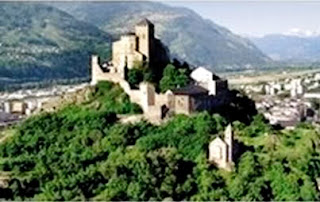
According to High End Travel Switzerland, Valère was a vast fortress - mentioned for the first time in 1049 - with a church and several houses within the wall rings. The church "Notre-Dame-de-Valère" dates back to the same period.
The church is 395 feet above the town of Valère on a steep hill.
Its "swallows nest organ" from the 14th-century is the oldest playable organ in the world.
According to Paul Hoffman, from the New York Times, "The organ, built in 1390 and most recently restored in 1954, is mounted on a wooden pulpit jutting out like a ship's bow from the rear wall of the Romanesque-Gothic church, once the Cathedral of Sion and one of Switzerland's most haunting edifices."

The organ has 10 ranks and 8 registers:
Pedal
Bass II
Manual
Principal 8
Octaf 4
Copl 4
Quint major 2 2/3
Superoctaf 2
Quint minor 1 1/3
Mixtur II

Intrigued? I think this organ is fascinating!
Here are two clips of the organ being played:
Thursday, February 11, 2010
Organ Tour: The John Wanamaker Grand Organ
According to TheaterOrgans.com, the Wanamaker Organ was built by the Los Angeles Art Organ company for the 1904 St. Louis World's Fair. The cost reached $105,000 and bankrupted the builder.
In 1909, John Wanamaker bought the instrument for his Philadelphia emporium and it was freighted from St. Louis where the installation took two years, after which it was greatly enlarged to fill the large space it occupied.
Virgil Fox on the Wanamaker organ:
Read more at Wikipedia.
Read more at Friends of the Wanamaker Organ.
In 1909, John Wanamaker bought the instrument for his Philadelphia emporium and it was freighted from St. Louis where the installation took two years, after which it was greatly enlarged to fill the large space it occupied.
Virgil Fox on the Wanamaker organ:
Read more at Wikipedia.
Read more at Friends of the Wanamaker Organ.
Subscribe to:
Posts (Atom)

 Posts
Posts

