August 7, 2010 Update: Please be aware that the organs are changing soon, so I believe this information will be out of date within the year. However, for general information, these reviews may still have some value to you, so I will leave this post up.
If your LDS church organ is quite old, or if you are getting a new building in your area, someone needs to choose an organ for the chapel. A couple of years ago I, too, had the opportunity to choose an organ when two of the chapels in my stake were approved for a new organ. Three of us, all organists, went on a tour of chapels in our area so that we could decide from experience which organs to choose.
Here is my review of the three organs that were available two years ago from the Church:
Allen
Allen has long been my favorite brand of organ. I even own an older Allen in my home. As of this writing, the model that is being installed is the AP22. Here's a link to the owner's manual:
http://www.lds.org/cm/pdf/OrganManual_Allen_Model_AP22_eng.pdf
Prior to my initial trial of the organs, this one was by far my favorite. The Swell 2nd voices, Great 2nd voices, and Pedal 2nd voices give many different registration options. I had grand visions of my prelude and postlude pieces--they would be varied and beautiful.
Unfortunately, the standard installation settings left a lot to be desired. After installation, the sound was far too soft. Additionally, the balance between the great and swell was so far off that even with the swell volume all the way up and the great all the way down, I still could not solo on the swell, as the great was much louder. Coupling the swell to the great had no effect whatsoever in hymn accompanying. Fortunately, in my new stake center we were able to have the installer back out to bump up the volume quite a bit, and to better balance the swell with the great. Now the organ balances the congregation beautifully.
As far as the second voices are concerned, instead of two separate Flute Celeste II stops, I would much prefer another Flute 8' option, as the flutes are limited on this organ. I would love to see an octave coupler on the Great and/or Swell. Another concern I had was that these voices might be confusing to a beginning organist who doesn't have access to a trained organist to show him/her the ropes.
My overall opinion is that this is a good organ when properly installed. It really has a beautiful sound and two different voicings to choose from: American Classic or Classic. A trained organist will probably have fun with this organ, and I feel that this organ is best suited in a building with a trained organist who can teach beginning organists how to use it to its fullest. Otherwise, all the bells and whistles will go unused. However, if you choose this organ, it's very important to make sure that your installer will adjust the volume and balance to your satisfaction, as mine did.
Rodgers
I will admit that I was never a Rodgers fan. The model that was installed in one of my former stake centers around 2000 sounded off to me. I didn't like the sound of the various stops and had a hard time finding registrations that I liked. Imagine my surprise when I fell in love with the sound in a new chapel!
http://www.lds.org/cm/pdf/OrganManual_Rodgers_Model_788L_eng.pdf It was beautiful, rich, and filled the chapel. I learned later that the installer tweaked the settings for the chapel it was installed in. This is key, I think, with any of the organs, as I'm mentioning in each review.
This organ is pretty basic--it doesn't have a lot of fancy bells and whistles, but has a nice solid sound for regular hymn accompaniment. There was a lack of nuance in the reeds, but overall I was pleasantly surprised.
I'd recommend the Rodgers for most chapels, especially if your stake lacks a trained organist, but I would not recommend it for a stake center--I like more bells and whistles for stake center installations. It would work just fine if that is your decision. If you have an accomplished organist they may feel the stop selection is the most limited of the three.
Johannus
The Johannus is a newcomer to the organ world.
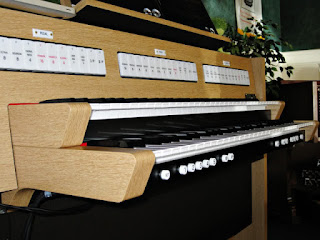
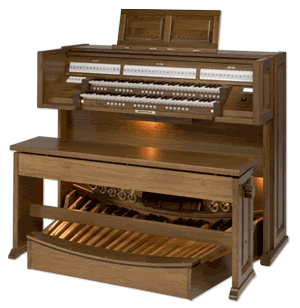
http://www.lds.org/cm/pdf/OrganManual_Johannus_Model_WM44_eng.pdf I've actually had the opportunity to play model WM44LDS the most of these three. Initially, the installation was much too soft (a common theme, I'm learning) and I was not a fan of it in a chapel, thinking the organ was small, cheaply made and better suited for home use. After having the installer back to make some adjustments (that are now standard on their installations) it quickly became my favorite of the three. It even comes with an instructional DVD.
This is a smaller organ, but it packs a big sound when properly installed. I like the variety of stop colors, but my very favorite feature of this organ is the Octave (Swell to Swell 4') coupler. Another great feature is that unlike most organs where you push the bottom of the rocker tab to select a stop and the top to deselect it, the Johannus will select or deselect in either place.
Overall, I think the Johannus is essentially a good blend of the Allen and Rodgers. The stop list is such that with the octave coupler it has a great range of voicings to choose from, both for prelude/postlude and hymn accompaniment. As always, proper installation is key.
Although it wasn't my favorite at first, the Johannus is now my number one recommendation for all chapels. It's not too confusing for a beginning organist, but has enough bells and whistles to keep an accomplished organist happy. You can't go wrong with this little organ.
In Conclusion
What did I choose and why? For the retrofit in my old stake center we chose the Allen. It is located in the center of town and is used for many cultural events, so we wanted an organ with the most variety of stops. The Allen, with all of the second voices, fit the bill. The other building houses long-established congregations from the center of town. We felt the Rodgers best suited their more traditional needs. For my new stake center, I was waffling between the Johannus, which I love, and the Allen, with all the voices, but before I could make my recommendation our stake presidency learned that the decision for an Allen had been made before the stake split.
You really can't go wrong with any of these organs. It all comes down to personal preference and proper installation. My recommendation is to see which installer will be the most willing to work with you and choose that organ.
Good luck!





 Posts
Posts


