Welcome to The Latter-day Saint Organist's Resource Blog

The purpose of this blog is to help pianists learn to become true organists. Many individuals believe that if you play the piano you can play the organ, but the instruments differ greatly. While this blog is specifically geared towards members of The Church of Jesus Christ of Latter-day Saints, much of the information shared can be utilized by all. I hope that the information I share here will help you become an effective organist in your ward, stake, or other congregation.

Feel free to browse and search this blog. It was started in January 2010 and while new posts aren't added very often, this blog contains a wealth of information and is a wonderful resource for all organists. If you're a new reader, you can find the first lesson here: Before We Begin: Acquiring the Essentials. Also, please "like" the corresponding facebook page, which is updated more often. A link is provided on the right sidebar, or you can click here.

Thanks for visiting!
Showing posts with label simple pieces. Show all posts

Thursday, March 11, 2010

Using Hymns Made Easy

As a pianist who has been called to play the organ, one of the challenges of learning to properly play the organ is time. With three or four hymns to learn each week, plus prelude and postlude, it's very difficult to learn proper organ technique and to execute it well. Since the vast majority of church organists don't have an organ in the home, this calling entails practicing the manuals on the piano but having to practice at the church as often as possible.

The inability to play hymns well after hours of practice can be very frustrating to a beginning organist. In order to provide confident accompaniment for the congregation, a new organist may wish to play one or more hymns or preludes from Hymns Made Easy, the full book of which is also available online.
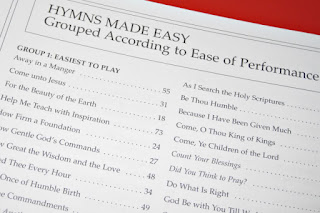
Ease of play

Hymns are even sorted according to difficulty (page 87).

Examples
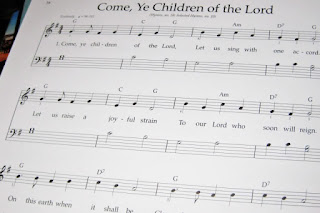
Come Ye Children of the Lord

"Come Ye Children of the Lord," on page 16, can be played with just the G in the pedals where the bass clef notes split. With a little bit of work, the moving bass line can be added in measures 10 and 12 by playing the A with the right heel, the G with the right toe, and the F# with the left toe.

There is a Green Hill Far Away

"There is a Green Hill Far Away," on page 51, can be played simply on the manuals, with the pedal added on the last note.
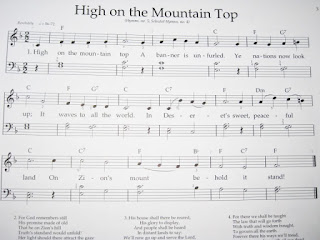
High on the Mountain Top

"High On the Mountain Top," on page 3, can be played using just the E and F in the pedal (the F with the right foot and the E with the left), or in the 8th measure a substitution to the right foot can be made, and the left foot can play the two C's before returning to prelocate the E. In measure 13 the right foot can play G, or not (with the toe, returning to F on the heel). The pick-up to measure 15 and measure 15 can be played with just the manuals, with the pedal re-entering with the right toe on the last note.

As Prelude or Postlude

With the melody line singled out and a very simple accompaniment line, these arrangements lend themselves to a solo and accompaniment registration, which we will cover in more depth in the future. Essentially, the right hand will play on one manual with a more prominent registration, and the left hand will play on the other manual with a softer registration which the pedal balances.

Combining a soft chorus registration for one verse, then changing to a solo and accompaniment registration for a following verse--mixing and matching the two registrations according to the spirit of each hymn--can be an effective way to utilize Hymns Made Easy for prelude or postlude.

In Conclusion

hymns

Whether an organist chooses to accompany the congregation from Hymns Made Easy or simply wishes to use them for prelude or postlude, this compilation can be a good resource for beginning ward organists.

Thursday, January 21, 2010

Review: Nine Hymn Studies by D. Kim Croft

Nine Hymn Studies

Nine Hymn Studies by D. Kim Croft is often recommended for beginning organ students. Each simple arrangement has complete fingerings and pedaling already marked.

Israel Israel God is Calling

According to the publisher, Jackman Music:
The nine hymns included in this book have very easy pedaling. The pieces range from medium easy to easy to play. Fingerings and pedal markings are also included.

Hymns included are:
"A Poor Wayfaring Man of Grief"
"Abide With Me"
"How Gentle God's Commands"
"How Great the Wisdom and the Love"
"In Humility, Our Savior"
"Israel, Israel God Is Calling"
"Jesus, the Very Thought of Thee"
"Oh How Lovely Was the Morning"
"Sweet is the Work"
I have always loved these hymn arrangements. As a beginning organ student, they were simple enough for me to play well. As a more accomplished organist they are beautiful enough that I still include them in my prelude music.

"A Poor Wayfaring Man of Grief"

While I enjoy all of these arrangements, of the nine this arrangement is my least favorite. With a time signature of 6/8, the pedaling is very simple, alternating between an Ab and Eb throughout the piece. The right hand plays the melody and left hand provides a nice counter-melody. I would like to see something slightly different in the pedals, but it is a nice, simple piece.

"Abide With Me"

With long sustained pedal tones, this arrangement only changes the bass note three times. A very reverent piece, the counter-melody beautifully balances the melody and pedal and provides a wonderful prelude piece.

"How Gentle God's Commands"

With only four pedal changes, this piece is simple and beautiful. This piece uses the heel on one beat, and, again, has a beautiful counter-melody.

"How Great the Wisdom and the Love"

I would classify this arrangement as one of the more difficult pieces in this collection, but it is by far my favorite. The pedaling is just slightly more advanced than the previous pieces, but it also has a beautiful manual-only section with tied notes that can be a bit tricky to properly execute on the organ. This piece also contains a key change.

"In Humility, Our Savior"

With the melody bouncing from right hand to left, this piece requires hands to change manuals three times. The bass is a sustained note for over half of the song, then moves around a bit during the latter-middle section.

"Israel, Israel God Is Calling"

This piece is another of my favorites. The bass note changes almost every measure (see photo above), and the counter-melody is beautiful.

"Jesus, the Very Thought of Thee"

Again, this piece has very simple pedaling which is balanced by a moving counter-melody in the left hand. It's a lovely reverent, reflective piece.

"Oh How Lovely Was the Morning"

This is another of the more difficult pieces in this collection. The melody is played by the left hand while the right hand plays a moving line peppered with staccatos. The bass line moves around a little bit as well.

"Sweet is the Work"

With simple pedaling and a moving counter-melody, this arrangement is fun to play and beautiful to listen to.

In Conclusion

You can't go wrong with this book of arrangements. They are beautiful in their simplicity, and with fingerings and pedaling already written in, this book is ideal for a beginning organist.