
Hans Andre Stamm on the Trost organ in Waltershausen, Germany, playing J. S. Bach's "Toccata and Fugue in D minor." Note the tracker action of the organ.
Sunday, March 14, 2010
Sunday Song: Bach's Toccata and Fugue in D minor
In honor of J.S. Bach's 325th birthday this month, the Sunday Songs will highlight a few of his works.
Hans Andre Stamm on the Trost organ in Waltershausen, Germany, playing J. S. Bach's "Toccata and Fugue in D minor." Note the tracker action of the organ.
Hans Andre Stamm on the Trost organ in Waltershausen, Germany, playing J. S. Bach's "Toccata and Fugue in D minor." Note the tracker action of the organ.

Thursday, March 11, 2010
Using Hymns Made Easy
As a pianist who has been called to play the organ, one of the challenges of learning to properly play the organ is time. With three or four hymns to learn each week, plus prelude and postlude, it's very difficult to learn proper organ technique and to execute it well. Since the vast majority of church organists don't have an organ in the home, this calling entails practicing the manuals on the piano but having to practice at the church as often as possible.
The inability to play hymns well after hours of practice can be very frustrating to a beginning organist. In order to provide confident accompaniment for the congregation, a new organist may wish to play one or more hymns or preludes from Hymns Made Easy, the full book of which is also available online.
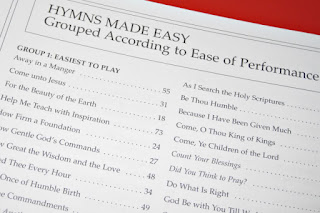
Hymns are even sorted according to difficulty (page 87).
Examples
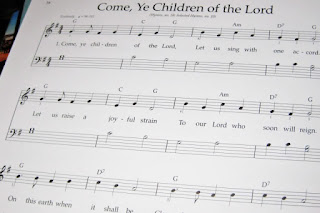
"Come Ye Children of the Lord," on page 16, can be played with just the G in the pedals where the bass clef notes split. With a little bit of work, the moving bass line can be added in measures 10 and 12 by playing the A with the right heel, the G with the right toe, and the F# with the left toe.

"There is a Green Hill Far Away," on page 51, can be played simply on the manuals, with the pedal added on the last note.
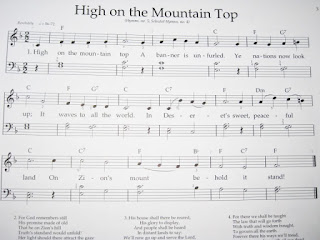
"High On the Mountain Top," on page 3, can be played using just the E and F in the pedal (the F with the right foot and the E with the left), or in the 8th measure a substitution to the right foot can be made, and the left foot can play the two C's before returning to prelocate the E. In measure 13 the right foot can play G, or not (with the toe, returning to F on the heel). The pick-up to measure 15 and measure 15 can be played with just the manuals, with the pedal re-entering with the right toe on the last note.
As Prelude or Postlude
With the melody line singled out and a very simple accompaniment line, these arrangements lend themselves to a solo and accompaniment registration, which we will cover in more depth in the future. Essentially, the right hand will play on one manual with a more prominent registration, and the left hand will play on the other manual with a softer registration which the pedal balances.
Combining a soft chorus registration for one verse, then changing to a solo and accompaniment registration for a following verse--mixing and matching the two registrations according to the spirit of each hymn--can be an effective way to utilize Hymns Made Easy for prelude or postlude.
In Conclusion

Whether an organist chooses to accompany the congregation from Hymns Made Easy or simply wishes to use them for prelude or postlude, this compilation can be a good resource for beginning ward organists.
The inability to play hymns well after hours of practice can be very frustrating to a beginning organist. In order to provide confident accompaniment for the congregation, a new organist may wish to play one or more hymns or preludes from Hymns Made Easy, the full book of which is also available online.
Hymns are even sorted according to difficulty (page 87).
Examples
"Come Ye Children of the Lord," on page 16, can be played with just the G in the pedals where the bass clef notes split. With a little bit of work, the moving bass line can be added in measures 10 and 12 by playing the A with the right heel, the G with the right toe, and the F# with the left toe.
"There is a Green Hill Far Away," on page 51, can be played simply on the manuals, with the pedal added on the last note.
"High On the Mountain Top," on page 3, can be played using just the E and F in the pedal (the F with the right foot and the E with the left), or in the 8th measure a substitution to the right foot can be made, and the left foot can play the two C's before returning to prelocate the E. In measure 13 the right foot can play G, or not (with the toe, returning to F on the heel). The pick-up to measure 15 and measure 15 can be played with just the manuals, with the pedal re-entering with the right toe on the last note.
As Prelude or Postlude
With the melody line singled out and a very simple accompaniment line, these arrangements lend themselves to a solo and accompaniment registration, which we will cover in more depth in the future. Essentially, the right hand will play on one manual with a more prominent registration, and the left hand will play on the other manual with a softer registration which the pedal balances.
Combining a soft chorus registration for one verse, then changing to a solo and accompaniment registration for a following verse--mixing and matching the two registrations according to the spirit of each hymn--can be an effective way to utilize Hymns Made Easy for prelude or postlude.
In Conclusion
Whether an organist chooses to accompany the congregation from Hymns Made Easy or simply wishes to use them for prelude or postlude, this compilation can be a good resource for beginning ward organists.
Monday, March 8, 2010
Lesson 9: Playing Your First Hymn
Click here for Lesson 8: The Manuals
In the past two lessons, we've tackled the manual and pedal parts of hymn 285, "God Moves in a Mysterious Way," but we haven't put them together yet. There are two methods we can use to do this: the 15-step and the 7-step.
The 15-step method to learning hymns

In Hymn Studies for Organists, Parley L. Belnap teaches the 15-step method, also called the "Individual Voice-Part Method."
Step 1: Learn just the soprano line, with proper breaks, ties, and fingering.
Step 2: Learn just the alto part, with proper breaks, ties, and redistribution/fingering.
Step 3: Learn just the tenor part with proper breaks, ties, and fingering.
Step 4: Learn just the bass part with proper breaks, ties, and pedaling.
Step 5: Play the soprano and bass lines together until perfect.
Step 6: Play the soprano and tenor lines together until perfect.
Step 7: Play the alto and tenor lines together until perfect.
Step 8: Play the soprano and alto lines together until perfect.
Step 9: Play the alto and bass lines together until perfect.
Step 10: Play the tenor and bass lines together until perfect (this can be very difficult)
Step 11: Play the soprano, alto, and bass lines together until perfect.
Step 12: Play the manuals, the soprano, alto, and tenor lines, together until perfect.
Step 13: Play the soprano, tenor, and bass lines together until perfect.
Step 14: Play the alto, tenor, and bass lines together until perfect.
Step 15: Play all four parts together until perfect.
This 15-step method seems very long, but it is very effective for a beginning organist. It allows you to focus on each line and the relationship between lines without being distracted by other parts. I highly recommend Dr. Belnap's 15-step method for beginning organists.
The 7-step method to learning hymns
This method is not as involved as the 15-step method, but is very effective for organists who are becoming more familiar with organ technique. At all times make sure the breaks, ties, and fingerings are correct
Step 1: Right hand alone
Step 2: Left hand alone
Step 3: Pedal alone
Step 4: Left hand and pedal (this is probably the hardest step)
Step 5: Right hand and pedal
Step 6: Right hand and left hand
Step 7: Right hand, left hand, and pedal
As you can see, this method does not isolate as many different voice combinations as the 15-step method.
Putting it all together
Using the 15-step method, play through hymn 285, "God Moves in a Mysterious Way." Although you should be able to play the manuals together and the pedals alone, take this time to ensure that your breaks, ties, and fingerings are correct. Play each part with the pedals. Work slowly and with a metronome to ensure that your tempo is steady, albeit very slow. If something sounds off, it's natural to blame the feet, but often the left hand is actually the culprit. For some reason the left hand likes to act up when the pedals are added. You may need to back up and repeat a step or two, and that's okay!
Once you reach step 15, slowly increase the tempo until you can play the hymn flawlessly at the proper tempo.
Homework
This week learn to play hymn 285, "God Moves in a Mysterious Way" up to tempo using the 15-step method and a metronome. Also, review the fingering techniques covered in Lesson 8: The Manuals. If you'd like, practice the Direct Fingering, Finger Crossing, and Finger Substitution examples from the New LDS Organist packet, page 15. Do not practice the thumb glissando exercises--we'll cover this technique at a later time.
In conclusion
Congratulations on learning to play your first hymn! In the next few lessons we will learn different hymns that utilize the various techniques we covered last week.
Continue on to Lesson 10: More Techniques in Hymns.
In the past two lessons, we've tackled the manual and pedal parts of hymn 285, "God Moves in a Mysterious Way," but we haven't put them together yet. There are two methods we can use to do this: the 15-step and the 7-step.
The 15-step method to learning hymns
In Hymn Studies for Organists, Parley L. Belnap teaches the 15-step method, also called the "Individual Voice-Part Method."
Step 1: Learn just the soprano line, with proper breaks, ties, and fingering.
Step 2: Learn just the alto part, with proper breaks, ties, and redistribution/fingering.
Step 3: Learn just the tenor part with proper breaks, ties, and fingering.
Step 4: Learn just the bass part with proper breaks, ties, and pedaling.
Step 5: Play the soprano and bass lines together until perfect.
Step 6: Play the soprano and tenor lines together until perfect.
Step 7: Play the alto and tenor lines together until perfect.
Step 8: Play the soprano and alto lines together until perfect.
Step 9: Play the alto and bass lines together until perfect.
Step 10: Play the tenor and bass lines together until perfect (this can be very difficult)
Step 11: Play the soprano, alto, and bass lines together until perfect.
Step 12: Play the manuals, the soprano, alto, and tenor lines, together until perfect.
Step 13: Play the soprano, tenor, and bass lines together until perfect.
Step 14: Play the alto, tenor, and bass lines together until perfect.
Step 15: Play all four parts together until perfect.
This 15-step method seems very long, but it is very effective for a beginning organist. It allows you to focus on each line and the relationship between lines without being distracted by other parts. I highly recommend Dr. Belnap's 15-step method for beginning organists.
The 7-step method to learning hymns
This method is not as involved as the 15-step method, but is very effective for organists who are becoming more familiar with organ technique. At all times make sure the breaks, ties, and fingerings are correct
Step 1: Right hand alone
Step 2: Left hand alone
Step 3: Pedal alone
Step 4: Left hand and pedal (this is probably the hardest step)
Step 5: Right hand and pedal
Step 6: Right hand and left hand
Step 7: Right hand, left hand, and pedal
As you can see, this method does not isolate as many different voice combinations as the 15-step method.
Putting it all together
Using the 15-step method, play through hymn 285, "God Moves in a Mysterious Way." Although you should be able to play the manuals together and the pedals alone, take this time to ensure that your breaks, ties, and fingerings are correct. Play each part with the pedals. Work slowly and with a metronome to ensure that your tempo is steady, albeit very slow. If something sounds off, it's natural to blame the feet, but often the left hand is actually the culprit. For some reason the left hand likes to act up when the pedals are added. You may need to back up and repeat a step or two, and that's okay!
Homework
This week learn to play hymn 285, "God Moves in a Mysterious Way" up to tempo using the 15-step method and a metronome. Also, review the fingering techniques covered in Lesson 8: The Manuals. If you'd like, practice the Direct Fingering, Finger Crossing, and Finger Substitution examples from the New LDS Organist packet, page 15. Do not practice the thumb glissando exercises--we'll cover this technique at a later time.
In conclusion
Congratulations on learning to play your first hymn! In the next few lessons we will learn different hymns that utilize the various techniques we covered last week.
Continue on to Lesson 10: More Techniques in Hymns.
Sunday, March 7, 2010
Sunday Song: Bach's Prelude & Fugue in D Major
In honor of J.S. Bach's 325th birthday this month, the Sunday Songs will highlight a few of his works.
Virgil Fox playing Bach's Prelude & Fugue in D Major at NHK Symphony Hall in Tokyo.
Virgil Fox playing Bach's Prelude & Fugue in D Major at NHK Symphony Hall in Tokyo.
Friday, March 5, 2010
Magnum Opus is Again Available

If you haven't yet, I recommend subscribing to the Mormon Tabernacle Choir List. It provides a wealth of information weekly. If interested, you can sign up here.
In today's email, I learned that Magnum Opus: The Building of the Schoenstein Organ At the Conference Center of The Church of Jesus Christ of Latter-day Saints, which includes a demonstration CD, is now in its second printing. It sold out very quickly the first time, and I missed it, so I quickly placed my order tonight.
You can order it from these sellers:
LDS Distribution Center
Deseret Book (10SCONF will save you 25% right now)
Organ Historical Society
I can't wait until I receive mine!
The full text from the email follows:
Applause for Magnum Opus -- now in second printing
Magnum Opus is a fascinating behind-the-facade glimpse of the design and building of the Schoenstein organ in the Conference Center of The Church of Jesus Christ of Latter -day Saints. The American Organist recommended "with pleasure, this fascinating and well written book."
Now in its second printing after its initial fall 2009 release -- which sold out quickly -- Magnum Opus is a story that needed to be told and is being applauded for its contribution to music history. There has never been an organ project quite like it. It is fitting that someone would write a book about it, one that would interest both the expert and the uninitiated. And not just anyone could have chronicled the story. Dr. Longhurst, Tabernacle organist for 30 years, was ideally qualified having been involved in the decisions from the first discussions in 1997 to the final completed instrument of 130 ranks inaugurated in 2003. "Longhurst writes as an insider," The American Organist states, "but he is aware of the responsibility he has to history to give an honest account of this remarkable installation."
"It was an ideal time to tell the story of an important organ," Dr. Longhurst contends, "while those who were principally involved are still alive and able to provide firsthand information." Not to mention the all-important paper trail.
"There are three reasons why this new instrument deserves study," The American Organist states. "It is large (five manuals, 130 ranks); it represents Schoenstein's distinctive ‘American Romantic’ style of organ building; and it is found within the vast space of a 21,000 seat auditorium. Such a combination easily qualifies this installation as unique and worthy of a monograph as distinguished as this one." In its recommendation the review also suggests, "No doubt many of the stories in this book will resonate with other organists, organ committee members, donors and clergy who have experienced (or should we say, ‘survived’) the selection, financing and installation of a large organ in a new edifice."
Magnum Opus is a publication of the Mormon Tabernacle Choir distributed by Carr Printing and is available at the locations mentioned above.
Thursday, March 4, 2010
Free Bach downloads
This month we celebrate the 325th birthday of J.S. Bach.
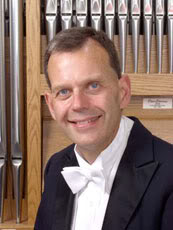
The complete organ works of Johann Sebastian Bach, recorded by James Kibbie on original Baroque organs in Germany, are now available as free Internet downloads. The University of Michigan's Block M Records label is offering free downloads of all 270 Bach works in MP3 and high audio-quality formats at www.blockmrecords.org/bach. James Kibbie recorded the series on seven historic organs by Silbermann, Schnitger, Trost, Bielfeldt, and Hildebrandt.
Bach was the supreme composers of the Baroque period, and is still one of the greatest composers of all time. Take some time and rediscover this master of musical science.
The complete organ works of Johann Sebastian Bach, recorded by James Kibbie on original Baroque organs in Germany, are now available as free Internet downloads. The University of Michigan's Block M Records label is offering free downloads of all 270 Bach works in MP3 and high audio-quality formats at www.blockmrecords.org/bach. James Kibbie recorded the series on seven historic organs by Silbermann, Schnitger, Trost, Bielfeldt, and Hildebrandt.
Bach was the supreme composers of the Baroque period, and is still one of the greatest composers of all time. Take some time and rediscover this master of musical science.
Monday, March 1, 2010
Lesson 8: The Manuals
Click here for Lesson 7: More pedaling.
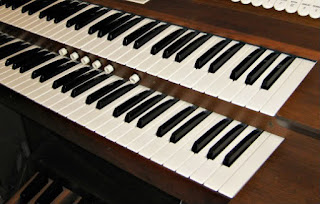
It's finally time to discuss the huge difference between piano and organ technique.
Posture
In past lessons we've discussed how to adjust the organ bench and how to center yourself on the pedal board. Now we'll discuss proper posture for manual playing.
It's very important to sit up straight while keeping your body relaxed and keeping the lumbar curve. Your wrists, elbows, and shoulders should be relaxed, with the elbows bent ninety degrees. Practicing on the lower manual as often as possible will help keep proper posture.
If you have long nails, it's time to bid them farewell. I've been guilty of playing with longer nails, and it's impossible to practice proper technique with nails in the way. (Some of my earlier videos show my poor technique that was necessary to compensate for long nails.) Once your nails are trimmed, place your curved fingers on the keys, and play by pulling the fingers towards you--instead of pushing down, pull inward.
Techniques
Regular, or Direct Fingering
This fingering technique mirrors piano technique. Placing fingers on adjoining keys, the fingers play and stretch or compress to play the notes without crossing or utilizing any other techniques.
Redistributing the Inner Part
Since the bass part is played with the pedals, the left hand only needs to play the tenor part. Many times the soprano and alto parts are difficult to finger with the right hand, so the left hand can grab the alto part--it is redistributed to the left hand.
Finger Crossing
Pianists are familiar with this technique--especially in scale exercises. Generally, a longer finger crosses over a shorter one, or a shorter finger crosses under a longer one. However, exceptions can be made in different circumstances.
Here is a simple exercise to practice up and down the keyboard:
Finger Glissando The finger or thumb slides from one note to another, from a black key to a white key.
Thumb Glissando The thumb glissando differs from playing a finger glissando with the thumb--it occurs from white key to white key, or white key to black key, a technique we will cover in a later lesson.
Finger Substitution In finger substitution, one finger is replaced by another during the same note so that the first finger is free to play another note.
Independent Movement One finger will sustain notes while another will lift. Different horizontal lines will operate independently, while being played by the same hand. This technique is essential to organ playing, and one that we will cover today.
Common Tones and Tying
Common Tones

Common tones are notes that are shared between voices in succession. For example, in hymn 198, "That Easter Morn," the D in the soprano/alto part in the first measure carries over to the alto part in measure two. lifting that D would create a break in the soprano/melody, so that D is tied.

The alto line on beat three of measure 6 is an F that is repeated in the soprano/alto on beat one of the next measure. A lift is necessary so that the melody is clear.
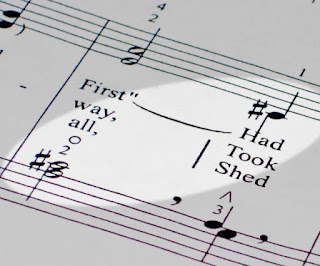
In measure 8, the C# in the tenor is repeated in the soprano/alto in beat three. It's important to lift so that the melody is heard and not just muddied into. As you can see, when the line above is ascending, the notes generally tie, as in the first example, and when the line above is descending, the notes generally break, as in the second and third example.
Tying Rules

In some hymns, all four voices repeat. Picking up and replaying all voices can cause a very choppy, non-legato sound. In this case, it is a good idea to tie one or two voices, depending on the speed of the hymn, to ensure that the hymn retains a legato sound. Never tie over bar lines (the only time you do this is to observe a common tone rule), and make sure you tie from strong beats to weak beats, not from weak beats to strong beats.
Practical Application
Break out Carol Dean's Hymns from the L.D.S. Hymnal Marked for the Organ, Hymn 285. In the last lesson we learned the pedaling for this hymn. Today we'll discuss the manual technique.
***Disclaimer: Carol is continually editing and changing the markings on these hymns. Your version may be slightly different from my 2006 version.***
Generally, in playing a hymn you will proceed similarly to the pedal technique we covered last time. When a note is repeated, lift and replay it. If a note changes, keep the legato line with no break or overlap. However, unlike the pedal technique we covered, there are times when common tones or tying rules come into play.
You'll notice that in the first full measure of "God Moves in a Mysterious Way," all four parts repeat. The alto part is tied through four beats to provide the legato discussed above. The alto part is also redistributed to the left hand. Practice just the left hand, Bb and G with fingers 2 and 4, holding the Bb as the G lifts on the last half of the beat through those first three beats, then the G holds through the fourth beat as the Bb lifts in preparation for beat five.
In measure three the right hand plays a similar passage, using fingers 1 and 3 on D and F. Play the D and F, hold the D while the F holds for 1/2 count, rests, three times, then provides a full count before direct fingering to Eb and G with fingers 2 and 4.
In measure five, the right hand again plays similarly, but with 2 and 4 on Eb and G.
As you practice, pay very careful attention to the breaks and legato fingerings. It may be helpful to play just the soprano, then just the alto, then just the tenor, then just the right hand, then just the left hand. Take your time, and only play as quickly as you can play perfectly. It may seem painfully slow, but slow is essential to learning proper technique. The organ is so different from the piano, that you are learning a brand new technique on a brand new instrument.
Here is the right hand:
Just the left hand:
Both hands together:
Homework
Learn the manual parts of this hymn this week. Work slowly and don't become frustrated if your progress is slower than you'd like. You are learning a brand new technique, and that takes a lot of time and practice. It will get easier, eventually, if you put in the necessary time and effort. The metronome marking in the Hymnal is 58-69 for the half note, which is 116-138 for the quarter note. Do not start anywhere near that fast, but eventually work up the speed, slowly, never playing faster than you can play perfectly. Review the bass part in the pedals that we covered last time, and slowly increase the tempo.
DO NOT put the manual and pedal parts together yet. We'll discuss how to best accomplish this in the next lesson. Practice the finger crossing outlined above. Play C and E with 1 and 3 of the left hand. Play D and F with 2 and 4. Play E and G with 1 and 5. Play F and A with 2 and 4. Play G and B with 1 and 5, etc. Then move back down. Repeat with the left hand an octave lower, but play C and E with 5 and 3, D and F with 4 and 2, E and G with 5 and 1, F and A with 4 and 2, etc. Then move back down.
In Conclusion
"God Moves in a Mysterious Way" is a good introduction to organ technique. While the hymn is quite simple, this new technique is not.
Once the manual and pedal parts are learned independently, we'll learn the best way to put them together in Lesson 9: Playing your First Hymn.
It's finally time to discuss the huge difference between piano and organ technique.
Posture
In past lessons we've discussed how to adjust the organ bench and how to center yourself on the pedal board. Now we'll discuss proper posture for manual playing.
It's very important to sit up straight while keeping your body relaxed and keeping the lumbar curve. Your wrists, elbows, and shoulders should be relaxed, with the elbows bent ninety degrees. Practicing on the lower manual as often as possible will help keep proper posture.
If you have long nails, it's time to bid them farewell. I've been guilty of playing with longer nails, and it's impossible to practice proper technique with nails in the way. (Some of my earlier videos show my poor technique that was necessary to compensate for long nails.) Once your nails are trimmed, place your curved fingers on the keys, and play by pulling the fingers towards you--instead of pushing down, pull inward.
Techniques
Regular, or Direct Fingering
This fingering technique mirrors piano technique. Placing fingers on adjoining keys, the fingers play and stretch or compress to play the notes without crossing or utilizing any other techniques.
Redistributing the Inner Part
Since the bass part is played with the pedals, the left hand only needs to play the tenor part. Many times the soprano and alto parts are difficult to finger with the right hand, so the left hand can grab the alto part--it is redistributed to the left hand.
Finger Crossing
Pianists are familiar with this technique--especially in scale exercises. Generally, a longer finger crosses over a shorter one, or a shorter finger crosses under a longer one. However, exceptions can be made in different circumstances.
Here is a simple exercise to practice up and down the keyboard:
Finger Glissando The finger or thumb slides from one note to another, from a black key to a white key.
Thumb Glissando The thumb glissando differs from playing a finger glissando with the thumb--it occurs from white key to white key, or white key to black key, a technique we will cover in a later lesson.
Finger Substitution In finger substitution, one finger is replaced by another during the same note so that the first finger is free to play another note.
Independent Movement One finger will sustain notes while another will lift. Different horizontal lines will operate independently, while being played by the same hand. This technique is essential to organ playing, and one that we will cover today.
Common Tones and Tying
Common Tones
Common tones are notes that are shared between voices in succession. For example, in hymn 198, "That Easter Morn," the D in the soprano/alto part in the first measure carries over to the alto part in measure two. lifting that D would create a break in the soprano/melody, so that D is tied.
The alto line on beat three of measure 6 is an F that is repeated in the soprano/alto on beat one of the next measure. A lift is necessary so that the melody is clear.
In measure 8, the C# in the tenor is repeated in the soprano/alto in beat three. It's important to lift so that the melody is heard and not just muddied into. As you can see, when the line above is ascending, the notes generally tie, as in the first example, and when the line above is descending, the notes generally break, as in the second and third example.
Tying Rules
In some hymns, all four voices repeat. Picking up and replaying all voices can cause a very choppy, non-legato sound. In this case, it is a good idea to tie one or two voices, depending on the speed of the hymn, to ensure that the hymn retains a legato sound. Never tie over bar lines (the only time you do this is to observe a common tone rule), and make sure you tie from strong beats to weak beats, not from weak beats to strong beats.
Practical Application
Break out Carol Dean's Hymns from the L.D.S. Hymnal Marked for the Organ, Hymn 285. In the last lesson we learned the pedaling for this hymn. Today we'll discuss the manual technique.
***Disclaimer: Carol is continually editing and changing the markings on these hymns. Your version may be slightly different from my 2006 version.***
Generally, in playing a hymn you will proceed similarly to the pedal technique we covered last time. When a note is repeated, lift and replay it. If a note changes, keep the legato line with no break or overlap. However, unlike the pedal technique we covered, there are times when common tones or tying rules come into play.
You'll notice that in the first full measure of "God Moves in a Mysterious Way," all four parts repeat. The alto part is tied through four beats to provide the legato discussed above. The alto part is also redistributed to the left hand. Practice just the left hand, Bb and G with fingers 2 and 4, holding the Bb as the G lifts on the last half of the beat through those first three beats, then the G holds through the fourth beat as the Bb lifts in preparation for beat five.
In measure three the right hand plays a similar passage, using fingers 1 and 3 on D and F. Play the D and F, hold the D while the F holds for 1/2 count, rests, three times, then provides a full count before direct fingering to Eb and G with fingers 2 and 4.
In measure five, the right hand again plays similarly, but with 2 and 4 on Eb and G.
As you practice, pay very careful attention to the breaks and legato fingerings. It may be helpful to play just the soprano, then just the alto, then just the tenor, then just the right hand, then just the left hand. Take your time, and only play as quickly as you can play perfectly. It may seem painfully slow, but slow is essential to learning proper technique. The organ is so different from the piano, that you are learning a brand new technique on a brand new instrument.
Here is the right hand:
Homework
Learn the manual parts of this hymn this week. Work slowly and don't become frustrated if your progress is slower than you'd like. You are learning a brand new technique, and that takes a lot of time and practice. It will get easier, eventually, if you put in the necessary time and effort. The metronome marking in the Hymnal is 58-69 for the half note, which is 116-138 for the quarter note. Do not start anywhere near that fast, but eventually work up the speed, slowly, never playing faster than you can play perfectly. Review the bass part in the pedals that we covered last time, and slowly increase the tempo.
DO NOT put the manual and pedal parts together yet. We'll discuss how to best accomplish this in the next lesson. Practice the finger crossing outlined above. Play C and E with 1 and 3 of the left hand. Play D and F with 2 and 4. Play E and G with 1 and 5. Play F and A with 2 and 4. Play G and B with 1 and 5, etc. Then move back down. Repeat with the left hand an octave lower, but play C and E with 5 and 3, D and F with 4 and 2, E and G with 5 and 1, F and A with 4 and 2, etc. Then move back down.
In Conclusion
"God Moves in a Mysterious Way" is a good introduction to organ technique. While the hymn is quite simple, this new technique is not.
Once the manual and pedal parts are learned independently, we'll learn the best way to put them together in Lesson 9: Playing your First Hymn.
Subscribe to:
Posts (Atom)

 Posts
Posts


